 >
>

A recent water quality story caught our eye out of Southern Nevada – mysterious brown foam found floating on Lake Mead.
According to an Associated Press Report, officials urged people to avoid the Overton Arm, a northern area of the lake, when several dozen carp were found dead in the foam, which extended for about eight miles from the mouth of the Virgin River to Echo Bay.
Water quality testing is underway, and the Nevada Department of Wildlife is investigating the fish deaths, according to the article, but the Southern Nevada Water Authority, monitoring water quality at two intakes, hasn’t found any problems.
The article quotes Southern Nevada Water Authority Spokesman Bronson Mack as saying no pollutants have been found at the intakes.
“It really is a massive body of water, and that’s one benefit from a drinking water perspective,” he told the Associated Press in regards to dilution, adding that water from the Overton Arm takes about a month to make it to the intakes.
In an www.8newsnow.com story, there was speculation of a virus killing the fish and an increase in water temperatures killing off algae to create the foam, meaning the two could be unrelated.
But in an editorial on lasvegascitylife.com, Peabody Award-winning reporter George Knapp raised some concerns.
“I would probably feel a bit better about drinking tap water from the lake if I hadn’t heard so many similar statements from our water officials in years gone by. SNWA and the Water District have spent millions over the years on touchy-feely TV commercials that assure all of us how great our water tastes and about all of the incredibly rigorous tests which are conducted thousands of times each month to ensure that every drop is perfectly safe,” Knapp wrote, referring to missed pollutants in Lake Mead like perchlorate that went undetected by testing for decades.
This will be an interesting story to follow, and one that drives home the importance of water quality monitoring.


Image via: http://pyramidlakeflyfishing.com/
What’s living in Northern Nevada’s water is an important indicator of water quality for our area, and in some cases can affect water quality, so news on aquatic species is always of interest here at WETLAB.
First, the good news. As reported by Tom Knudson in the Sacramento Bee, the Pyramid Lake Lahontan Cutthroat Trout is recovering from near extinction.
“This is such an exciting story because this was such a unique fish,” said Mary Peacock, an associate professor of biology and genetics expert at the University of Nevada, Reno, in the Sacbee story. “You can see pictures from the early part of the 1900s with people holding really large trout out of Tahoe or Pyramid. We thought those fish were gone.”
The particular strain of Cutthrought Trout was overfished in the 1920s and 30s, but the construction of the Derby Dam on the Truckee River to divert water meant the fish could no longer reach their spawning grounds, dealing what was thought to be the final blow, according to the story.
But survivors were found in an unlikely place, Morrison Creek on the Nevada Utah boarder, and a slow, tenuous reintroduction was underway.
On the scarier side of aquatic wildlife news, the Reno Gazette Journal is reporting that the Nevada Department of Wildlife has confirmed that New Zealand mudsnails – an invasive species that can do serious damage to a lake or river, has been detected in the Truckee River.
The small snail can be the size of a grain of sand or up to an eighth of an inch, but can out-compete native species and wreak havoc on a stream’s ecosystem, according to the article.
Looking upstream to Tahoe and other lakes that feed the Truckee River, the specter of invasive species may not be as ominous as once thought, however.
An in-depth review of national scientific studies indicates that quagga and zebra mussels, long thought to pose a significant risk to Tahoe, Donner and other area lakes, may not be able to survive in the calcium-poor bodies of water, according to “the Saga of the Quagga” by David Bunker, published in Moonshine Ink.
This recent revelation has put mandatory, paid boat inspections on Donner Lake on hold, according to the article, while the science is reviewed.
These are all important issues for the Northern Nevada region’s water quality, and will all be important to keep an eye on as they continue to develop.
In this blog, we spend much of our time talking about water quality testing news, science and politics that we find interesting; but with this month’s blog, we decided to do something a little different.
Here at WETLAB we care about maintaining and improving water quality, above and beyond our roll in monitoring it. When we came across some tips for average citizens to help from www.cleanwateraction.org, we thought it was a great fit.
First is some news that’s been getting quite a bit of attention in the last few years: Don’t flush medicines, pharmaceuticals or personal care products down the toilet or down the drain. That includes anything from over-the-counter drugs to cosmetics and even sun screen or vitamins. They can all impact both the environment and our drinking water down the road.

Don’t use antibacterial soaps when you don’t need to. These products often contain chemicals that harm aquatic life, and can lead to antibiotic resistant germs.
Don’t put motor oil, detergents, fertilizers, pesticides or anything but water down storm drains. And speaking of motor oil, fix any drips or leaks on your car or truck so it doesn’t wash into the water supply with the rain.
Try to use natural gardening products over pesticides or chemical fertilizers. The same goes for inside the home–stay away from toxic household products in cleaning and home care.
Pick up after your pets! Their waste contains bacteria that can end up in the water supply when it’s washed down the storm drain.
Pave less of your property. The more water runs across pavement instead of seeping down into the soil, the greater chance it has to pick up pollutants, pick up speed and cause flooding or erosion.
These are just a few tips we thought were worth sharing. Please add your ideas by commenting on this post or on our Facebook page.


Earlier this winter, we took a look at a promising beginning to the winter’s snowpack and corresponding water storage after big December storms.
Our January WETLAB blog reported end-of-December totals of 112 percent water content in the Sierra Snowpack that feeds the Truckee River and the Reno-Northern Nevada area downstream. At the time, that put us at 53 percent of the year’s total.
Fast forward to the end of February, and the picture is a little different – because the water is about the same. Yes, the months of January and February were the driest ever recorded for the Northern Sierra since modern records were first kept in 1920, according to the San Jose Mercury News, putting us at only 66 percent of normal to date.
Snowfall, stored in the Sierra to melt throughout the spring and summer as one of the major water sources for both Nevada and California, has been blocked by a ridge of high pressure off the West Coast for the last two months, driving storms up into Canada, and dropping them into the Midwest.
And accordingly, water officials are tightening their belts. The Walker River Irrigation District said farmers might receive about half of what they received last year, even though last year was also a below average year for water in the Sierra snowpack, according to the Reno Gazette Journal.
That – despite this year’s snowpack holding more water than last year – is due to drawn-down reservoir levels, according to Federal Watermaster Jim Shaw.
“I hate to bear crappy news, but being an old farmer, it doesn’t look very good,” Shaw said in the RGJ article. “If it’s any consolation, it’s this way clear across the U.S., from the Mississippi River west.”
While the April 1 deadline for measuring Sierra snowpack and water stored therein is quickly approaching, some local forecasters aren’t quite ready to write this winter off.
Snow Forecaster Bryan Allegretto of opensnow.com writes that, depending on which forecasting model you look at, there’s still a chance at feet of snow before the month of March is up.
The bottom line – if you’re an optimist, it’s not over until its over, but if you’re not, we’re unlikely to make up for the ground lost in January and February.
Water Quality Award Goes To UNR Educator
WETLAB would like to congratulate Susan Donaldson, University of Nevada Cooperative Extension water quality education specialist, on receiving the McCurry Excellence in Water Quality award!
Presented by the Nevada Division of Environmental Protection, Donaldson was recognized earlier this month for her extensive and long-time contributions to water quality in Nevada.
Highlights in Donaldson’s work in the field of water quality include leading a statewide tall whitetop and noxious weed education campaign, where she received a Silver Spike Award of Excellence, she established the Nonpoint Education for Municipal Officials Nevada Program to provide water quality education for land-use decision making, she partnered with public agencies to create the Water Wise Program, and she launched a pesticide applicator safety training website with the Nevada Department of Agriculture, according to an article from Nevada Today, University of Nevada, Reno.
She has presented her work around the world, speaking at the 13th Australian Weeds Conference in Perth, Western Australia, according to the article.
“Dr. Donaldson’s water quality education efforts have greatly informed the public. She is directly responsible for helping stakeholders apply their knowledge and skills to solve community environmental challenges,” said Colleen Cripps, administrator of the Nevada Division of Environmental Protection in the article. “We are thrilled to be able to recognize her efforts with this year’s Wendell McCurry Award.”
The award, established in 1999, honors Wendell McCurry who, over a 33-year career, advocated for water quality, established Nevada’s water quality standards and represented the state on the National Association of Clean Water Administrators.
WETLAB appreciates Donaldson’s work in water quality and specifically her contributions to educating both our state’s decision makers and the public on the important issues of water quality.

Sierra Snowpack water content off to a strong start!
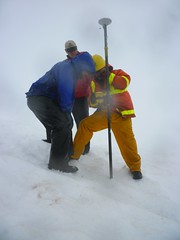
Measuring snow depth with GPS (Photo credit: WSDOT)
It’s that time of year again – the time when intrepid snow surveyors head out into the Sierra Nevada Mountains to assess how much water is stored in the winter’s snowpack.
California Department of Water Resources surveyors went out for the first look at the end of December and confirmed what we all expected – there’s a lot of water already stored in the snow, ready to flow downstream to Nevada and California in the spring.
The Central Sierra region, which includes the Truckee River – the primary water source for the Reno-Sparks region, holds 112 percent of normal water content for this date, and 53 percent of the yearly total measured April 1st each year.
The Northern Sierra reports 117 percent and 56 percent for those two stats, and the Southern Sierra shows 109 percent and 47 percent, according to the California Department of Water Resources.
After last winter’s dry spell, some in Nevada are still cautious, however.
According to a Reno Gazette Journal article, Federal Watermaster Jim Shaw told the Walker River Irrigation District Board to be cautious, with some long term forecasts showing below normal precipitation for January through March.
Frank Gehrke, chief snow surveyor for the California Department of Water Resources, shared the same caution in a San Francisco Chronicle article.
“We’ve got a real good start to the year, but still three months to go where we need to have more snow,” he said in the article. “From a skier’s standpoint, it’s gorgeous. You can’t get much better in California than we’ve got now. The thing that is always on our minds, though, is whether this sunny weather will keep up for long.”
Still, things look a lot better than last year, according to the article, with 4 feet of snow measured by Gehrke (1 foot of water content) this year, compared to 4 inches of snow – 0.14 inches of water – for the same time last year.
So the bottom line is this – we’re off to a good start, but let’s keep our fingers crossed for more snow to come!

Measuring snow depth with style (Photo credit: WSDOT)

Tahoe Governing Body Passes Water Quality Plan
Here at WETLAB, Western Environmental Testing Laboratory, we keep an eye on water quality issues throughout Northern Nevada and the surrounding region, and perhaps no other place within the region gets more attention than Lake Tahoe.
Recently, the Tahoe Regional Planning Agency, a bi-state agency that governs Lake Tahoe, passed an update to it’s 1987 regional plan in a 12-1 vote – an update that took the better part of a decade, according to an article in the Tahoe Daily Tribune.
The overarching goal of the plan is to reduce polluting runoff into the lake that reduces clarity – specifically targeting fine sediments that stay suspended in the water and nutrients that aid in growth, according to the article.
The updates specifically will allow investment in old, outdated properties that are known sources of runoff into Lake Tahoe.
But the TRPA has drawn criticism from both developers and from environmentalists, and it’s contentiousness has drawn the discussion out over many years.
Developers believe the Regional Plan to be to restrictive of construction and development so far as to hamper economic growth, while environmental groups contend the plan does not do enough to address the TRPA’s environmental goals.
The update allows increased building height, building density and developed coverage around the lake, according to critics, the article states.
“Earthjustice has represented local interests and conservation groups in the past to protect the lake and regions around its shoreline from unbridled construction and development,” said Earthjustice Attorney Wendy Park on the issue. “The population of California is growing rapidly and Lake Tahoe needs stronger, not weaker, protections to stay the very special mountain lake everyone cherishes.”
Whether the update is faced with legal challenges is not yet known, according to the article.
This will be an interesting water quality issue to watch, both for Northern Nevada and Northern California.


Sunrise over a smoky Northern Nevada (Photo credit: lacomj)
Cloud Seeding – Milking More Moisture out of Clouds for Northern Nevada
It sounds like science fiction to those who are unfamiliar, but it’s a practice that’s been in place in Northern Nevada and the California mountains to the west for more than 25 years.
Cloud Seeding – a practice in which mountaintop generators spray particles of silver iodide into storm clouds to boot ice particle formation and snowfall – has been said to increase the snowpack that feeds the Truckee River (Reno/Sparks major water supply) by an average of about 18,000 acre-feet per year, according to an article in the Reno Gazette Journal.
According to the Desert Research Institute, over the last 15 years cloud seeding has created enough snow water to supply 140,000 households annually over the last 15 years.
Last year, a particularly dry year for the Sierra and Northern Nevada, along with much of the west, DRI estimated an increase of 21,600 acre-feet of water, according to the RGJ article.
For reference, an acre-foot of water is 325,851 gallons – enough to supply two average homes for more than a year.
Funding was cut to the Desert Research Institute by the state legislature in 2009, but regional government entities, including the Truckee Meadows Water Authority and Western Water Commission are poised to pay for the process again this year.
“We feel it’s money well spent,” said Mark Foree, general manager of the Truckee Meadows Water Authority. “Certainly anything that can help our snowpack is something we are interested in.”
In considering the water quality impacts on spraying silver iodide into clouds to create snow and rain, the Weather Modification Association says “There is no evidence that suggests cloud seeding creates any significant negative environmental impacts on the environment. Assessments of soil, vegetation and surface runoff haven’t shown levels of silver iodine above natural background levels.
Desert Research Institute’s cloud seeding is expanding, starting with a 3-year program in southern Nevada to boost the snowpack in the Walker River watershed.
What do you think of cloud seeding? Let us know by commenting on this post on our Facebook page.

English: Cloud seeding. Deutsch: “Impfung” von Wolken um künstlich Regen zu erzeugen. (Photo credit: Wikipedia)

We believe that no one in the world should go hungry. In order to do something about that as a company, we volunteer once per month at the the Food Bank of Northern Nevada. Our efforts help fuel the Food Bank’s mission to end hunger in the region through direct services, advocacy, outreach and education. Our entire office heads down to the Food Bank to support this effort.
We’re not afraid to roll up our sleeves and coordinate a team effort to separate and pack boxes that are distributed to the FBNN’s partner agencies that serve the needy, ill and elderly, as well as thousands of children. In one trip, we can pack and seal up to 500 boxes.
The Food Bank of Northern Nevada’s donations are delivered to a number of local outlets and programs, including emergency food pantries and senior meal programs, low-income day care centers, drug and alcohol rehabilitation centers, family and domestic violence shelters and various youth programs. Those organizations offer bags of groceries, meals or snacks to those in need. The Food Bank of Northern Nevada’s service area is more than 90,000 square miles. We are incredibly proud to support their efforts and help our community stay nourished and healthy.
Snapshot Day isn’t a WETLAB photo shoot. It’s an annual Lake Tahoe Basin and Truckee River Watershed citizen-monitoring event. Launched back in 2000, Snapshot Day is designed to promote environmental education and stewardship while also collecting valuable water quality information. Snapshot Day takes place at locations throughout the Lake Tahoe and Truckee River Watersheds.
During Snapshot Day, we work with students and other volunteers to field-test streams, collect discrete water samples for nutrient analysis, and educate participants on protecting and improving the watershed in their own backyard. The data collected helps provide a “snapshot” of water quality and stream conditions all throughout the region.
It’s truly a great opportunity to learn about your local watershed and get more involved in a great locally-driven environmental event. Snapshot Day is run by volunteers, but spearheaded by the Tahoe-Truckee Clean Water team and sponsored by local environmental and water-focused agencies, including WETLAB. Our participation as a sponsor and team dates back to 2009 and we’re proud to support the program and its commitment to protecting the watershed in our community.


