 >
>

Winter Forecasting from WETLAB – Western Environmental Testing Laboratory

OSTM/Jason-2’s predecessor TOPEX/Poseidon caught the largest El Niño in a century seen in this image from Dec. 1, 1997. (Photo credit: Wikipedia)
This time of year, many skiers, snowboarders and other snow-lovers in Northern Nevada and elsewhere start to wonder what kind of winter is coming.
But the winter’s snowfall affects more than just the ski slopes – it’s what supplies water to much of Nevada, California and the rest of the west. Here in the Reno area, the forecasts that get the most attention is what will happen up the hill in the Lake Tahoe Region.
There are a variety of long-term forecasts to choose from, and all have varying levels of success.
Accuweather.com first predicted big snowfall in the Sierra, but in their October 14 forecast, they’ve backed off, not predicting above or below average snowfall for the region.
“Rain and (mountain) snow in California this coming season, I believe, will be near normal for the most part. A little bit more in the southern half than the northern half is expected,” said AcccuWeather Long-Range Forecaster Paul Pastelok.
The long-standing Farmer’s Almanac calls for milder than normal temperatures than normal, with average precipitation.
Early indications showed the possibility of El Nino conditions, created by warmer temperatures in the Pacific that historically have meant more precipitation in the Southwest and less in the Northwest, but according to a local forecaster at tahoeweatherdiscussion.com, El Nino conditions continue to weaken.
It’s tough to tell what El Nino, or its opposite, La Nina, mean for the Reno-Tahoe area, as last year’s below average snowfall came with a weak La Nina, and the huge snowfall of the winter before came with a stronger La Nina.
On 14 of the last 60 winters have been neutral – neither La Nina or El Nino – making predictions even more difficult, according to tahoeweatherdiscussion.com.
So the bottom line? There don’t seem to be any strong predictors yet. We’ll have to wait and see what the winter brings, and hope for the best to replenish our water supplies.

English: Snowy forest in Boreal, near Lake Tahoe, in the Sierra Nevada of California. (Photo credit: Wikipedia)

Stopping Nevada Water Pipeline With Snails?
Here’s an interesting water quality story bubbling up in Nevada right now: an environmental group has filed a suit to get four species of tiny springsnails as protected to keep Las Vegas from pumping billions of gallons of water from rural areas.
The Southern Nevada Water Authority has been granted approval in March to pump up to 84,000 acre-feet of groundwater a year from four rural valley to Las Vegas by Jason King, Nevada’s state engineer, according to an article by the Associated Press.
In August, the U.S. Bureau of Land Management recommended approval of the 280-mile long pipeline that would cost $3 billion.
Las Vegas has been the center of water controversies in the past with its rapid growth and associated thirst – a metropolis now home to 2 million people and host to 40 million tourists a year.
And Environmental groups have argued the plan to pump water would greatly reduce ground water levels – threatening wildlife, agriculture, ranching and rural communities, according to the AP article.
The latest lawsuit from the Center for Biological Diversity was filed in the U.S. District Court in Washington DC, asking the Fish and Wildlife Service to issue conclusions on whether the bifid duct, flag, hardy and Lake Valley pyrg springsnails deserve protection under the Endangered Species Act, according to the article.
In a preliminary finding last year prompted by a petition from the Center for Biological Diversity in 2009 found the snails, measuring about an eight of an inch to a quarter of an inch in size, may warrant protection.
The suit doesn’t target the Southern Nevada Water Authority or its pipeline project, but would give opponents more ammunition in fighting it, according to the Associated Press.
The snails date back to the ice age, said Rob Mrowka, a Nevada Advocate with the Center for Biological Diversity in the AP story, isolated as ice receded to evolve independently in accordance to the conditions of each spring.
They are an important part of the ecosystem, depended on by frogs, toads dragonflies, damsel flies, desert fish, birds and animals, according to the article.

Oh,the Places WETLAB will Go!
Tri—State- on- the -River in Primm, NV Sept 25-27
http://www.tristateseminar.com

The Truckee River Cleanup is Saturday, September 29, 2012, at 8:30 a.m.

Geothermal Energy Expo September 30-October 3
http://www.geothermalenergy2012.com/

Carson River Snapshot Day Friday October 19th 8-12pm.

Northwest Mining Expo in Spokane
http://www.nwma.org/convention.asp


Cropped transparent version of Image:Olympic flag.svg (Photo credit: Wikipedia)
Water Quality and the London Summer Olympics
Browsing around the internet, looking at the latest news in the water quality word, WETLAB came across a few headlines that caught our attention – both regarding the Summer Olympic Games in London.
What could water quality have to do with the summer games? According to www.envirotech-online.com, there are two topics of interest – clean competition water for aquatic events, and the green practice of recycling sewage at the Olympic Park in London.
According to their article, water quality is actually strictly monitored for aquatic competition by the National Swimming Clubs Governing Body. For this summer’s games, the events in the aquatic center governed by that body include swimming, diving, synchronized swimming and the swimming part of the modern pentathlon.
And on the water quality conservation front, the Olympic Park in London is recycling sewage water for use in toilets and in landscaping, according to Environmental Technology Online. The treated wastewater will also be used for cooling in the energy center.
This takes a step beyond the already green practices of harvesting rainwater and recycling grey water, and under the spotlight of the Olympic Games, could become an example of efficient water use and conservation, according to the Olympic Delivery Authority, an organization responsible for venues, infrastructure and the legacy of the 2012 Summer Olympic and Paralympic Games in London.
Sewage, or black water, has the advantage of being a more predictable, steady supply of water for applicable uses than captured rain water or even grey water, according to the article. The ODA found that treating sewage for use in toilets and irrigation actually used less energy than extracting and treating ground water for drinking water purposes.
Along with efficient fixtures reducing the use of drinkable water by 58 percent, this black water recycling program stands to put a sizeable dent in water usage by the Olympic Games.
Here in Northern Nevada, a place where water isn’t particularly plentiful, these technologies could be of great interest.
At Wetlab, we’re always interested in unique water quality topics like these that came out of the Olympic Games. Let us know what you think by commenting on this story on our Facebook page.
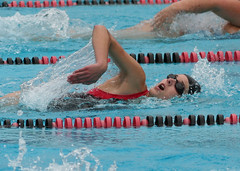
swimming (Photo credit: Jim Bahn)

We want to encourage kids to explore and discover using science and experimentation. That’s why for the past two years our WETLAB team in Elko, headed by Andrew Porter, has volunteered to run a science-oriented station for Eastern Nevada Cub Scout troops at Spring Creek High School.
Andrew grew up as a curious Cub Scout and is still involved with the Boy Scouts as the highest ranking Eagle Scout. In addition, several of the Elko employees have little ones in the Scout programs.
This year, he participated in the annual Boy Scouts day camp. With over 100 scouts from around Eastern Nevada, Andrew conducted fingerprinting with the kids for the CSI-themed day. It was a rewarding experience, allowing Andy and WETLAB to not only volunteer with the scouts, but pass on a love of science and get kids excited about it.
It was a pleasure to take our love for man’s best friend and use it to get some exercise while supporting an organization so close to our hearts, The Nevada Humane Society. In May 2013, several WETLAB team members approached Michelle about participating in the two-mile Walk for Animals.
We raised $1,268 before the event and Michelle was happy to match that amount as a gift from WETLAB. The walk took place at the Sparks Marina and we all brought our leashed friends to participate in the walk and other pet-friendly activities. The money we raised went to serve the more than 10,000 homeless animals in the area!
Robots with Smartphones, the Next Tech in Water Quality Monitoring?

English: Taking Water Samples (Photo credit: Wikipedia)
So when we came across an article on www.waterworld.com about University of California, Berkeley engineers launching a fleet of 100 floating robots on the Sacramento River, we took notice.
According to the article, the Floating Sensor Network Project, led by associate professor Alexandre Bayen, offers a quickly-deployable real-time data picture of tough-to-map rivers and streams.
The project is actually an evolution of previous research from Bayen, where he used GPS-enabled smartphones to monitor traffic flow, according to the article.
In a waterway, the floating robots work in much the same way, mapping the intricate way in which the water is moving – critical for understanding the spread of pollutants.
“If something spills in the water, if there’s a contaminant, you need to know where it is now, you need to know where it’s going, you need to know where it will be later on,” said Andrew Tinka, a Ph.D. candidate in electrical engineering and computer sciences and the lead graduate student on the project in the article. “The Floating Sensor Network project can help by tracking water flow at a level of detail not currently possible.”
Down the line, the robots could also be set up to monitor other aspects affecting water quality, like temperature or contaminant levels, rather than just water speed and movement – making them even more valuable for real-time water quality monitoring.
But the technology isn’t perfect yet, as the floating robots tend to get hung up on the shores, requiring close supervision – so the ability to avoid obstacles is on the to-do list, Tinka said in the article.
“In the future, cost and size will go down, while performance and autonomy will go up, enabling monitoring at unprecedented scales,” said Bayen in the article. “We expect this to become an invaluable tool for the future management of a critical resource in this state and around the world.”
The continued advancement of our ability to monitor the quality of water, an increasingly precious resource, can only be a good thing, and here at WETLAB, we’re excited to play a part in that ongoing progress.

Following our mantra that no one should ever go hungry, we began volunteering at the Reno-Sparks Gospel Mission. Once per month, the WETLAB team dishes up breakfast for the women and children that come to Mission and helps put together more than 1,000 meals to help improve the lives of those in need. With more than 50 years of serving the Reno-Sparks communities, the Reno-Sparks Gospel Mission is a model organization that demonstrates a never-ending dedication to helping others. In total, the Gospel Mission has served nearly 8 million meals to homeless individuals and families.
Since the start of 2013, when the WETLAB team made a decision to support the Reno-Sparks Gospel Mission, we’ve had a chance to bond as professionals over hot meals that reach the hands and mouths of those less fortunate than us. It is our pleasure to continue serving meals and supporting the efforts of the Reno-Sparks Gospel Mission.
LAS VEGAS REVIEW-JOURNAL
For most people, a drink of water is like eating or sleeping. It’s just something we do to stay alive.
The Western Environmental Testing Laboratory’s work is one of the reasons people rarely think about the water they drink. The Sparks-based lab handles wastewater and drinking water testing for private companies, research firms and municipalities to ensure its safety.
The company in December opened a Las Vegas branch at 3230 Polaris Ave., to better accommodate its 10 local clients. Utility Services owner Hollie Daines is a recent addition to WETLab’s client roster. Her company is distribution operator for 45 local small public water systems, ranging from homeowners associations to resorts. WETLab analyzes the water samples Utility Services collects from the systems each month.
Click here to read more!

The Las Vegas Wash – upstream view. (Photo credit: Wikipedia)

2012 Snapshot Day – Getting a Complete Water Quality Picture of Reno/Tahoe
Reno Tahoe residents, want to roll up your sleeves and do something about water quality in our region? The 8th annual Water Quality Snapshot Day needs volunteers Saturday, May 10.
This is a cause near and dear to our hearts here at Western Environmental Testing Laboratory – WETLAB, and we’ve worked as team leaders since the beginning. But you don’t need to be a water quality expert – you just need to care about our regions rivers, lakes and streams.
The idea is to get volunteers from all around Lake Tahoe and along the Truckee River to Pyramid Lake to take water quality samples in order to create a holistic picture of our region’s water. The event not only provides valuable data to area researchers on a large scale, but it’s also a great excuse to get outside and enjoy our region’s beautiful waterways!
All you have to do is meet for a brief orientation at 8:30 a.m. Saturday, May 10. Reno area volunteers will meet at Bartley Ranch Regional Park, 6000 Bartley Ranch Road.
Truckee area volunteers will meet at the Sagehen Field Station, about 10 miles north of Truckee on Highway 89 North.
North Lake Tahoe volunteers will meet at Sierra Nevada College in Incline Village, and South Lake Tahoe volunteers will meet at the Lake Tahoe Community College cafeteria.
Volunteers will be lead by trained group leaders, fanning out across our watershed to various locations on a variety of streams and tributaries, testing for dissolved oxygen, conductivity, pH and temperature, also collecting water samples for laboratory analysis of nutrients, sediments and bacteria. All this data will give important insights into the health of our waterways. You’ll also learn interesting information about our watershed from your team leader.
To sign up as a volunteer, call Mary Kay Riedl at 775-687-9454 for Reno area, Beth Christman at 530-550-8760 for the Truckee area or Susie Kocher at 530-542-2571 for Lake Tahoe.

Map showing the Truckee River drainage basin. (Photo credit: Wikipedia)


