 >
>

WETLAB has been recognized for being a women’s business enterprise (WBE). The certification was awarded on February 22 by the Women’s Business Enterprise Council – West, a regional certifying partner of the Women’s Business Enterprise National Council (WBENC).

WETLAB President Michelle Sherven
“Having an association with WBE recognizes the growing role that women are playing in STEM (Science, Technology, Engineering, Mathematics) industries and careers,” says Michelle Sherven, owner of WETLAB. “The environmental testing field in particular is male-dominated, so we are proud to offer exceptional testing services to this industry as a woman-owned company.”
WBENC’s national standard of certification is a meticulous process, including an in-depth review of the business and a site inspection. The certification process is designed to confirm that the business is at least 51 percent owned, operated and controlled by a woman or women. According to WBENC: by including women-owned businesses among their vendors, corporations and government agencies demonstrate their commitment to fostering diversity and the continued development of their supplier/vendor diversity programs.
About WBENC: The Women’s Business Enterprise National Council is the nation’s largest third-party certifier of businesses owned and operated by women in the United States. WBENC is a resource for the thousands of U.S. companies and government agencies that rely on WBENC’s certification as an integral part of their vendor diversity programs. www.wbenc.org
Our ongoing series Life of a Sample explores what happens behind the scenes at WETLAB. If you missed part one, check it out here!
The next step for a sample at WETLAB is sample preparation. This process takes one day, and involves several different processes and people. During the first step, all samples undergo the same log-in and review procedure, and sample prep is where the tests begin to diverge dependent on which analyses are required. Some samples, including many soil tests, require the compositing of several different samples into one representative batch. For many tests, different filtered and unfiltered aliquots are needed; these pieces are split up into different bottles and preserved as needed. Once properly split, the samples are released to the lab.
Before the samples reach the lab, laboratory scientists clean and prep the necessary equipment, and lab technicians prepare batches of samples based on the tests logged in during step one. Some tests are ready to preform immediately, and those move on to step three. For others, extractions are needed. This includes TCLP (toxic characteristic leaching procedure), cyanide extraction, MWMP (meteoric water mobility procedure), and humidity cells. Some of these extractions take more than one day, like humidity cells, which can continue for a few months up to several years. Ensuring proper preparations are preformed allows the rest of the analysis to run smoothly. After the filtering and extractions are completed, it’s time for step three: distillation and digestion.

A portion of the humidity cells currently being processed in the geochemistry lab.

MWMP extractions.
Have you ever wondered what happens behind the scenes at WETLAB? You drop off a sample, then ten days later, you receive results. Simple, right? Well, there is a lot that happens from the time a cooler full of samples comes in the door to the time that you get results. In this six-part series, Life of a Sample, you will get an inside look at what happens as a sample flows through the lab. At WETLAB, we pride ourselves on the quality of our work, and the way that we handle your project exemplifies that.
The first part of sample life begins before a specimen has ever been collected. We begin with pre-project planning, which involves determining how WETLAB can make your project a reality. Our stellar project managers work with you to figure out what you need done, and how we can make it happen. This involves liaising with our lab manager, quality assurance manager, operations manager, and business development manager to ensure that we have the proper resources in place to preform all required and requested testing services. Once a project scope has been discussed and agreed to, you gather your samples and bring them to lab (or have one of our friendly couriers pick them up). When the samples arrive in the lab, the real fun starts.
A sample is received, along with a detailed Chain of Custody, by one of our knowledgeable client service representatives. The sample is then logged in and checked for any initial errors in preservation, temperature, etc. After that, the samples undergo two levels of quality assurance and control before they ever reach the lab. The first is primary entry into the laboratory management system. Once the primary entry is done, the sample is split into the necessary sets, and preserved and/or filtered if needed. When the samples are in the proper containers for analysis, a second set of eyes reviews them and the initial data entry to ensure accuracy. After the secondary review, the samples are ready to be released to the lab to begin analysis. This intensive initial receiving takes about four hours, ensuring plenty of time for the next five steps to occur. Next up: Step 2, Sample Preparation.

Client Services staff doing primary and secondary review of new samples.

Project Manager Hollie checking a sample against a COC to ensure initial accuracy.
No one living on the West coast has been able to escape the boisterous predictions about El Niño and its potential impact this winter. At WETLAB, we have been keeping a close eye on what the experts are saying about the storm, and keeping our fingers crossed that it means lots of new snow. However, there are new predictions out saying that El Niño may bring a lot of moisture, but it might be warm. This spells bad news for our drought-stricken region, where it was recently found that the snow pack in the Sierra Nevada’s is at a 500-year low. Of course, some moisture is better than none, but rain brings a higher possibility of mudslides and erosion. Sadly, there is no way to know what’s going to happen until it happens, so now we must all wait with baited breath and crossed fingers, hoping for snow.

Predicted El Niño weather pattern, courtesy of Accuweather.com
Nevada is home to many beautiful, expansive, and green golf courses. But, Nevada is also a dry, arid desert which is currently going through a severe drought, and there’s no end in sight. How are these two seemingly irreconcilable realities coexisting? Well, that’s a multi-faceted answer.
Golf courses go hand-in-hand with Nevada’s hospitality and luxury industries, and companies would be hard pressed to simply let their green investments die a brown, crunchy death. So companies, and courses, have gotten a little creative. While they started with the obvious measures of reducing overall usage, and examining pipes for leaks, the reduction was simply was not enough. Golf courses have now started using treated effluent water as a means for watering their massive lawns. Many courses in Nevada, especially those lining the Las Vegas strip, have used gray water for several years, but effluent water is a newer usage concept. Effluent water differs from gray water in that it must be more treated, since it can contain sewage. Using effluent water, instead of fresh water or even gray water, means a reduction of demand for potable water, which in turn means that our dwindling water supply can hold out a bit longer.
Northern Nevada golf courses have capitalized on the use of treated effluent water as a means to water their grass. It’s clear that the water-saving measure isn’t negatively impacting the golf courses, too, because the lawns are bright green and thriving. You just have to drive by Washoe County’s Sierra Sage Golf Course in Stead to see that this is a great way to water the turf. Sierra Sage gets their water from the City of Reno’s Stead Water Reclamation Facility, where the effluent water is treated to the point where it is no longer dangerous, but still not potable.
Another impact of this ever-worsening drought? Shorter winters mean more time on the putting green.
WETLAB tests effluent water for EPA compliance, and water for golf courses is no exception. WETLAB will also test all of your runoff and fertilizer samples, call (775) 355-0202 for more information.
Effluent water could soon become part of your normal drinking water in Northern Nevada. According to KTVN, reclaimed water is around 30% cheaper than potable water, but the problem is that waste water is not drinkable yet. Yet is the key word here, because regulations that define how much the water will need to be treated are working their way through the Nevada state legislature, and lawmakers are hoping to see them adopted by the 2017 session.
As everyone knows, Northern Nevada is suffering a severe drought. Having another way to reuse water will have a great, positive environmental impact on our already low waterways. Effluent water is already being used in some ways, mostly to irrigate parks and golf courses, but more could be put back into eventual use by the proposed measure. The process involves injecting semi-treated water directly into the ground, so that it will later make its way back into our pipes. This will ease the strain that is currently put on the Truckee River, which will in turn help with our ecosystem.
Effluent water is defined as waste-water, whether treated or not, that flows out from an industrial treatment plant or sewer. Secondary effluent is that same water that has been treated, but not to the point of purity. Obviously, the main difference between potable and effluent water is the cleanliness of the water, and its fitness for human consumption.
WETLAB preforms several tests on effluent water for many different clients, including public and private companies. Some of these tests are Biochemical Oxygen Demand (BOD), which tests how much oxygen demand the effluent water has, and Total Suspended Solids (TSS), which tests the amount of suspended solids within an aqueous sample. Several other tests are often performed in tandem on effluent water samples, including Total Nitrogen, Nitrate + Nitrite, Ammonia, Total Phosphorous, and Fecal Coliform. These tests all provide a detailed profile of what exactly is contained in an effluent sample, and allow proprietors to know how to best treat their water.
Singapore and Texas have already implemented effluent-to-drinking-water purification systems, with positive results. To read more about this program in Nevada, and to see an interesting news report on it, click here.
The Environmental Protection Agency (EPA), in conjunction with the U.S. Army Corps of Engineers, recently finalized the Clean Water Rule. This rule is aimed at protecting our nation’s water resources from pollution and human ruin, especially the smaller streams and wetlands.
This rule is an attempt to make a difference in larger waterways by cleaning the smaller upstream streams and wetlands that feed them.
There is no expanded authority with the instatement of the Clean Water Rule, because the EPA already has the authority to impose these regulations based on the authority granted in the Clean Water Act.
Some farmers and property owners have expressed concern about regulations regarding smaller streams, but environmental groups laud the new rule as long overdue.
WETLAB continues to test water for EPA compliance. See how we can help you comply with the new regulations by calling us at (775) 355-0202, or emailing us at info@wetlaboratory.com
More information about the Clean Water Rule can be found here, via the Environmental Protection Agency.
According the Reno Gazette-Journal, the recent rains experienced by northern Nevada and Lake Tahoe will ultimately have little impact on lake water levels. The recent precipitation has pushed Lake Tahoe up to its natural rim, but will drop as the weather continues to warm.
There has been a reported 1.42 inches of rainfall in South Lake Tahoe between May 14 and 25, and just about one inch in Reno-Sparks.
While any rain is good for our local water table, the amount we received in May is simply not enough to make a large difference for the rest of the summer. By the end of the summer, Lake Tahoe is expected to be several feet below its rim.
The long standing drought in California and Nevada shows few signs of stopping anytime soon.
More about this story can be found here.
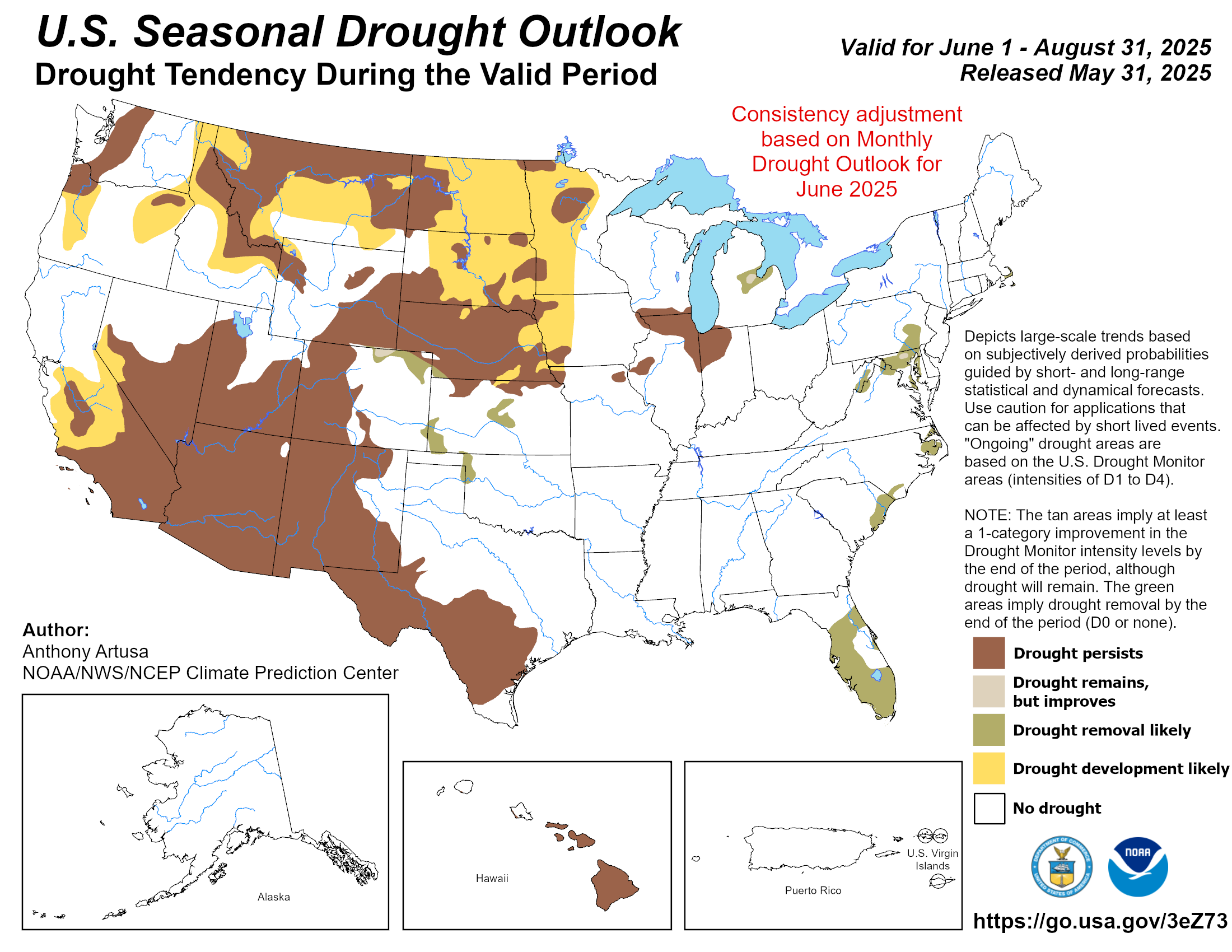
2015 Seasonal Drought Outlook, Courtesy of the National Weather Service Climate Prediction Center
With the Sierra snowpack 1/3rd of normal for this time of year, it doesn’t look like a recovery from drought conditions are likely, according to an article on KSBW.com.
A survey earlier this month found the Truckee River Basin was only at 32 percent of normal, the Tahoe Basin was at 47 percent and the Carson River Basin was at 55 percent, according to the article. It’s an improvement from a month prior, where the snowpack was as low as 14 percent of normal.
While reduced irrigation and watering are a typical reaction to pending drought conditions, some experts in the Reno area are actually urging residents and businesses to water trees to help them survive the drought, according to an article written by the Associated Press.
The Reno Urban Forestry Commission says the region has seen a significant increase in tree deaths over the past several years, which is a threat to public safety and requires costly removal, according to the article.
Effective March 6, 2014: The Bureau of Mining Regulation and Reclamation (BMRR) announces updated certified methods for mercury analysis required in Part I.D of the Water Pollution Control Permit.
WETLAB will no longer utilize the analytical method 200.8, Determination of Trace Elements in Waters and Wastes by Inductively Coupled Plasma using Mass Spectrometry, for testing non-potable water from Nevada mine sites.
The updated required EPA analysis is 245.1, Determination of Mercury in Water By Cold Vapor Atomic Absorption Spectrometry. Along with this change, the BMRR is requiring that all tests that occurred in January and February are updated, using the 245.1 analytical method.
WETLAB is currently certified by EPA 245.1 and has already begun to process samples that still remain within the EPA suggested hold time.
WETLAB has also contacted clients to inform them how this change has affected their 1st quarter samples.
Please contact the WETLAB Client Services Manager Kurt Clarkson at 775-355-0202 with any questions.
Thank you


