 >
>

Sierra Snowpack water content off to a strong start!
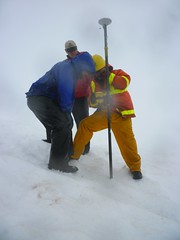
Measuring snow depth with GPS (Photo credit: WSDOT)
It’s that time of year again – the time when intrepid snow surveyors head out into the Sierra Nevada Mountains to assess how much water is stored in the winter’s snowpack.
California Department of Water Resources surveyors went out for the first look at the end of December and confirmed what we all expected – there’s a lot of water already stored in the snow, ready to flow downstream to Nevada and California in the spring.
The Central Sierra region, which includes the Truckee River – the primary water source for the Reno-Sparks region, holds 112 percent of normal water content for this date, and 53 percent of the yearly total measured April 1st each year.
The Northern Sierra reports 117 percent and 56 percent for those two stats, and the Southern Sierra shows 109 percent and 47 percent, according to the California Department of Water Resources.
After last winter’s dry spell, some in Nevada are still cautious, however.
According to a Reno Gazette Journal article, Federal Watermaster Jim Shaw told the Walker River Irrigation District Board to be cautious, with some long term forecasts showing below normal precipitation for January through March.
Frank Gehrke, chief snow surveyor for the California Department of Water Resources, shared the same caution in a San Francisco Chronicle article.
“We’ve got a real good start to the year, but still three months to go where we need to have more snow,” he said in the article. “From a skier’s standpoint, it’s gorgeous. You can’t get much better in California than we’ve got now. The thing that is always on our minds, though, is whether this sunny weather will keep up for long.”
Still, things look a lot better than last year, according to the article, with 4 feet of snow measured by Gehrke (1 foot of water content) this year, compared to 4 inches of snow – 0.14 inches of water – for the same time last year.
So the bottom line is this – we’re off to a good start, but let’s keep our fingers crossed for more snow to come!

Measuring snow depth with style (Photo credit: WSDOT)

Winter Forecasting from WETLAB – Western Environmental Testing Laboratory

OSTM/Jason-2’s predecessor TOPEX/Poseidon caught the largest El Niño in a century seen in this image from Dec. 1, 1997. (Photo credit: Wikipedia)
This time of year, many skiers, snowboarders and other snow-lovers in Northern Nevada and elsewhere start to wonder what kind of winter is coming.
But the winter’s snowfall affects more than just the ski slopes – it’s what supplies water to much of Nevada, California and the rest of the west. Here in the Reno area, the forecasts that get the most attention is what will happen up the hill in the Lake Tahoe Region.
There are a variety of long-term forecasts to choose from, and all have varying levels of success.
Accuweather.com first predicted big snowfall in the Sierra, but in their October 14 forecast, they’ve backed off, not predicting above or below average snowfall for the region.
“Rain and (mountain) snow in California this coming season, I believe, will be near normal for the most part. A little bit more in the southern half than the northern half is expected,” said AcccuWeather Long-Range Forecaster Paul Pastelok.
The long-standing Farmer’s Almanac calls for milder than normal temperatures than normal, with average precipitation.
Early indications showed the possibility of El Nino conditions, created by warmer temperatures in the Pacific that historically have meant more precipitation in the Southwest and less in the Northwest, but according to a local forecaster at tahoeweatherdiscussion.com, El Nino conditions continue to weaken.
It’s tough to tell what El Nino, or its opposite, La Nina, mean for the Reno-Tahoe area, as last year’s below average snowfall came with a weak La Nina, and the huge snowfall of the winter before came with a stronger La Nina.
On 14 of the last 60 winters have been neutral – neither La Nina or El Nino – making predictions even more difficult, according to tahoeweatherdiscussion.com.
So the bottom line? There don’t seem to be any strong predictors yet. We’ll have to wait and see what the winter brings, and hope for the best to replenish our water supplies.

English: Snowy forest in Boreal, near Lake Tahoe, in the Sierra Nevada of California. (Photo credit: Wikipedia)

Oh,the Places WETLAB will Go!
Tri—State- on- the -River in Primm, NV Sept 25-27
http://www.tristateseminar.com

The Truckee River Cleanup is Saturday, September 29, 2012, at 8:30 a.m.

Geothermal Energy Expo September 30-October 3
http://www.geothermalenergy2012.com/

Carson River Snapshot Day Friday October 19th 8-12pm.

Northwest Mining Expo in Spokane
http://www.nwma.org/convention.asp

LAS VEGAS REVIEW-JOURNAL
For most people, a drink of water is like eating or sleeping. It’s just something we do to stay alive.
The Western Environmental Testing Laboratory’s work is one of the reasons people rarely think about the water they drink. The Sparks-based lab handles wastewater and drinking water testing for private companies, research firms and municipalities to ensure its safety.
The company in December opened a Las Vegas branch at 3230 Polaris Ave., to better accommodate its 10 local clients. Utility Services owner Hollie Daines is a recent addition to WETLab’s client roster. Her company is distribution operator for 45 local small public water systems, ranging from homeowners associations to resorts. WETLab analyzes the water samples Utility Services collects from the systems each month.
Click here to read more!

The Las Vegas Wash – upstream view. (Photo credit: Wikipedia)

2012 Snapshot Day – Getting a Complete Water Quality Picture of Reno/Tahoe
Reno Tahoe residents, want to roll up your sleeves and do something about water quality in our region? The 8th annual Water Quality Snapshot Day needs volunteers Saturday, May 10.
This is a cause near and dear to our hearts here at Western Environmental Testing Laboratory – WETLAB, and we’ve worked as team leaders since the beginning. But you don’t need to be a water quality expert – you just need to care about our regions rivers, lakes and streams.
The idea is to get volunteers from all around Lake Tahoe and along the Truckee River to Pyramid Lake to take water quality samples in order to create a holistic picture of our region’s water. The event not only provides valuable data to area researchers on a large scale, but it’s also a great excuse to get outside and enjoy our region’s beautiful waterways!
All you have to do is meet for a brief orientation at 8:30 a.m. Saturday, May 10. Reno area volunteers will meet at Bartley Ranch Regional Park, 6000 Bartley Ranch Road.
Truckee area volunteers will meet at the Sagehen Field Station, about 10 miles north of Truckee on Highway 89 North.
North Lake Tahoe volunteers will meet at Sierra Nevada College in Incline Village, and South Lake Tahoe volunteers will meet at the Lake Tahoe Community College cafeteria.
Volunteers will be lead by trained group leaders, fanning out across our watershed to various locations on a variety of streams and tributaries, testing for dissolved oxygen, conductivity, pH and temperature, also collecting water samples for laboratory analysis of nutrients, sediments and bacteria. All this data will give important insights into the health of our waterways. You’ll also learn interesting information about our watershed from your team leader.
To sign up as a volunteer, call Mary Kay Riedl at 775-687-9454 for Reno area, Beth Christman at 530-550-8760 for the Truckee area or Susie Kocher at 530-542-2571 for Lake Tahoe.

Map showing the Truckee River drainage basin. (Photo credit: Wikipedia)

WETLAB – Western Environmental Testing Laboratory takes a closer look at Water Quality Around The World.
We spend a lot of time looking into water quality here in Northern Nevada. A lot of time. So when we came across a Gallup poll on water quality around the world, we took a step back, to take a broader look.
Gallup surveyed residents in 145 countries around the world, asking, “In the city or area where you live, are you satisfied or dissatisfied with the quality of water?”
The highest satisfaction levels, measured by percent satisfied, were not surprisingly in the United States, Canada, western and northern Europe, according to the poll.
While the USA had 87 percent of respondents say they were satisfied – the same as Canada and Ireland – Both the United Kingdom and the Netherlands ranked higher at 91 and 92 percent respectively. Denmark, Norway and Sweden all took the top mark at 94 percent.
The other end of the spectrum, also not surprisingly unfortunately, where sub-Saharan African countries. At the bottom of the survey results was Chad, with only 21 percent of respondents were satisfied with water quality. Also on the low end were Nigeria and Ethiopia, both at 29 percent, Liberia, at 30 percent and Tanzania, at 35 percent.
It wasn’t all bad in sub-Saharan Africa – with Malawi, South Africa and Namibia at 79, 81 and 82 percent respectively.
Former Soviet Bloc countries also showed strong dissatisfaction, with Ukraine at 26 percent, Russia at 30 percent and Kazakhstan at 49 percent.
The rest of Asia runs from a low of 35 percent in Lebanon and 43 percent in Cambodia to 98 percent in Singapore. In the world’s largest population centers, China and India, satisfaction rated 75 percent and 68 percent respectively.
In the western hemisphere, Latin America and the Caribbean ranged widely Gallup said this water-rich area was prone to exploitation and contamination.
In the Caribbean, Haiti was at 44 percent, and the polling was done before the devastating earthquake of 2010. But nearby Jamaica responded much more positively, at 89 percent.
Guyana, a small country on the northern edge of South America, responded at 54 percent satisfied, while Uruguay to the south ranked at 91 percent. Mexico fell somewhere in the middle at 70 percent.
To see the complete results, go to http://www.gallup.com/poll/105211/water-quality-issue-around-world.aspx

View of a rosette sampler, used to collect water samples for water quality testing. This type of sampler can be used in deep water for locations such as the Great Lakes and oceans. (Photo credit: Wikipedia)
.

Here at WETLAB Western Environmental Testing Laboratory, water quality is our business. It effects everybody – from healthy drinking water to a healthy environment. But today everybody also needs to think about water quantity, not just water quality.
Water shortages are growing larger and becoming more frequent. The World Bank reports that 80 countries are experiencing water shortages and more than 2 billion people don’t have access to clean water, according to The University of Arizona College of Agriculture and Life Sciences.
The problem is the inevitable consequence of a growing world population – doubling the demand on water every 21 years, according to the University.
Most of us use know the basics of using water wisely – from not running the tap while brushing your teeth to making less water intensive choices when landscaping. But the U.S. Environmental Protection Agency is aiming to up your knowledge on how to save water through easy education and simple guidelines, available at www.epa.gov/watersense/.
Educational tools great for the whole family include a quiz titled “ Test Your WaterSense,” a calculator will let you figure out how much you can save at home, a guide shows you local rebates for saving and more.
Their guidelines for flushing, for example, could reduce toilet flush rates by 20 percent and urinal flush rates by 50 percent, according to the Green Education Foundation.
“If one in every 10 homes in the United States were to install WaterSense labeled faucets or faucet accessories in their bathrooms, it could save 6 billion gallons of water per year, and more than $50 million in the energy costs to supply, heat and treat that water,” according to the EPA.
Those fixtures and appliances have been independently tested for efficiency and performance to meet the EPA WaterSense standard.
And it’s already working, saving 125 billion gallons of water and $2 billion in utility bills in the last five years, according to Stephanie Thornton, as quoted by the Green Education Foundation.
Here in Northern Nevada, the Truckee Meadows Water Authority also offers guidelines for saving water and implementing assigned day watering for landscaping.
We’re in a high desert environment, subject to the snow pack of the Sierra Nevada, so while last winter may have left our region relatively flush, we never know what Mother Nature has in store for us in the next year.
In Southern Nevada, the Las Vegas Sun has set up a count down to when Las Vegas could theoretically run out of water (2021!) if water usage isn’t changed.

Viva Las Vegas! As for Vegas, the lease is completed and we’re currently setting up and going through the certification process for the test we will perform in Vegas. We will perform locally Total Coliform, Quant Tray, Fecal Coliform, pH and BOD5.
The address is 3230 Polaris Ave. Unit 4, Las Vegas, NV 89102.
For additional information please contact Nick Ross at (775) 355-0202.
Lake Tahoe snowmelt floods water sampling labs, hydrologists with work
A web of agencies and scientists work day and night each spring to monitor the aquatic health of one of North America’s most majestic alpine lakes
In the world of water quality monitoring, there is perhaps no more majestic setting or no more intense industry epicenter than Lake Tahoe.
Twenty-two miles long, more than 1,500 feet deep — and surrounded by vacation homes, ski resorts, casinos and lodges — Tahoe is the perfect mix of jaw-dropping, crystalline natural treasure and highway- and home-ringed recreation Mecca that has fueled an intense, long-term web of water quality monitoring programs to gauge the lake’s aquatic health.
Over the span of more than 50 years, scientists have deployed all throughout the year, all across the lake, to gauge sediment loading, nutrient concentrations and water clarity.
But one time of year — when the mountains of snow that ring that lake begin to slowly succumb to the spring’s long days and warm sun — brings of a flood of water quality monitoring work to sampling labs, scientists, non-profit groups and regulators.
The few weeks when spring runoff intensifies — swelling streams and filling the lake with fresh snowmelt — is one of the most critical annual cycles for the clarity of the lake. It is then that agencies can gauge if BMPs (Best Management Practices) are filtering road grime and sediment from construction sites, driveways and roadways. It is then that the effects of the millions of dollars that are regularly invested in catch basins, filtration ponds, and stream and wetland restoration are calculated.
Hydrologists, volunteers and laboratories are flooded with work, literally working day and night to pinpoint the effect of stormwater drainage on one of the world’s most studied bodies of water.
“If [runoff peaks] at 12 o’ clock at night on Christmas day, you go out a monitor then because you don’t want to miss that. Often you are out there in the middle of the night or on weekends,” said John Reuter, associate director of U.C. Davis’s Tahoe Environmental Research Center.
While the waters of Lake Tahoe have been monitored since 1958, agencies have only recently been examining the precise effects of stormwater drainage on Lake Tahoe’s water quality. In 2003, in conjunction with the EPA-mandated Total Maximum Daily Load program, agencies began sampling 16 stormwater sites around the lake. The results confirmed that 70 percent of the fine particles that end up clouding Lake Tahoe’s clarity are coming from urban sites.
Lake Tahoe’s three pollutants of concern — Phosphorous, Nitrogen and fine sediment — are tested and gauged by agency and private labs in the region. Phosphorous and nitrogen stimulate algae growth in the lake, which clouds the lake’s clarity, and sediment that is five times less thick than a human hair, gets suspended in the water, also impairing Tahoe’s famed crystalline waters.
Laboratories like nearby Sparks, Nev.-based WETLAB brace for the flood of laboratory work that each spring runoff season brings.
WETLAB’s state-of-the-art lab was built in 2006 to accommodate the increasing monitoring workload of water analysis from nearby agencies, mining regulators and environmental non-profits. The lab’s business, built on all types of regulatory compliance and environmental restoration work — from Lake Tahoe water testing to environmental testing around mining sites — has boomed in the past year. WETLAB has grown revenue by nearly 30 percent in the last year and hired over 11 full- and part-time employees.
“WETLAB braces for spring each year, knowing that snowmelt means our busy season is here,” said Michelle Sherven, president of WETLAB. “We have even added services, like a dedicated shuttle between our lab and Lake Tahoe, to help busy agencies and non-profit complete important water tests on time during the tense runoff months.”
The precision of the water quality testing is incredibly important as the results guide heavy federal, state and local investment in the environmental future of the lake.
Some of the fixes to the stormwater pollutants that run off of roads, driveways and roofs are simple and common — street sweeping to catch sediment before it is washed into the lake or filtration basins. But when dealing with very fine sediment and minute particles that wash swiftly from shoreline urban areas into the lake, some unique, cutting-edge solutions to Lake Tahoe’s stormwater pollution are being considered, said Reuter.
Ideas like a “pump-and-treat” system — where stormwater is pumped uphill to a man-made filtration area or a natural watershed where the sediment can slowly filter out of the water before it reaches the lake — are being talked about.
Whatever direction the efforts to maintain and restore Lake Tahoe’s famed water clarity take, springtime will continue to be a critical season for scientists, regulators and laboratories to gauge the condition of one of the nation’s most treasured natural wonders.

On January 11th, 2011 The Nevada Division of Environmental Protection, Bureau of Mining Regulation and Reclamation (BMRR) issued a statement clarifying the acceptable methods for the analysis of Weak Acid Dissociable, or “WAD”, cyanide. The statement listed two acceptable methods: ASTM D2036-082 and SM 4500CN I.
Keep in mind this concerns only compliance monitoring samples that are being reported to BMRR. The issued statement doesn’t cover any sample that is not for compliance, or is being reported to any other agency.
Both acceptable methods are manual distillation methods that use a weak acid (glacial acetic acid) to break up easily dissociated cyanide complexes, capture the free cyanide in solution, and then analyze the solution using a few different techniques. These two methods have long been thought to be the most reliable techniques for the quantification of cyanide in waters. BMRR stated that only data obtained using one of these two methods would be acceptable for compliance monitoring.
Western Environmental Testing Laboratory (WETLAB) has been using SM4500CN I for the analysis of WAD cyanide for many years and is currently certified by the State of Nevada, Bureau of Water Quality Planning. Just like any method or technique that WETLAB wishes to use for compliance monitoring sample analysis, we have gone through a rigorous certification program that includes an on-site audit and the analysis of “blind” QC samples.
Over the last decade new techniques have been developed for the analysis of the easily dissociated cyanide complexes that WETLAB hopes become acceptable for BMRR reporting. One specific method is known as Flow Injection Ligand Exchange or F.I.L.E. cyanide. WETLAB is already certified and equipped to use this more efficient and environmentally sound testing method, which would provide clients with quicker turn-around time for results. Should BMRR choose to accept data generated from this technique, WETLAB will contact clients to inform them of our wish to change methodologies.
As always, if you have any questions regarding the information contained in this blog, don’t hesitate to call (775) 355-0202.


