
As summer comes to a close, another dry season has taken its toll on Southern Nevada water supplies.
Drought conditions have dropped water levels in Lake Mead to “near critical levels,” according to 8newsnow.com, putting Las Vegas Valley water supply in a tight spot.
The situation has gotten bad enough that Las Vegas water officials may seek federal disaster aid, according to ktvn.com.
In a comment to the Las Vegas Review Journal, Southern Nevada Water Authority chief Pat Mulroy compared the severity of the situation to Hurricane Sandy, which hit the East Coast last year.
Lake Mead’s water level has dropped more than 100 feet since 2000, according to ktvn.com.
If Lake Mead drops to 1,075 feet, Nevada will be forced to cut water usage by 4 percent, according to 8newsnow.com. The lake was at 1,106 feet, as of August 8, and falling fast.
The Southern Nevada Water Authority cannot pull water out of Lake Mead if it drops below 1,000 feet, but is drilling a third “straw” into the lake to gain deeper access in case levels continue to drop.
Many are viewing this as a long-term issue, and one that will have to be dealt with on a larger scale.
“They really all see, as do most scientists, the fact that we’re not really in a period of drought. It is climate change,” Dr. Stephen Parker of University of Nevada, Las Vegas, told 8newsnow.com.
And according to federal water experts and climatologists, the picture is grim for all of the South West that depends on the Colorado River for water, according to an article in the Las Vegas Sun.
Demand for water from the Colorado River exceeds current supply, according to the article, meaning the government may have to spend between $4 and $7 billion to ensure a more stable supply for Nevada, Arizona, California, Utah, Colorado, Wyoming and New Mexico.
This situation only reinforces the importance of properly, and carefully, managing not only our water supply in the west, but insuring the water we do have is kept at high water quality standards so it isn’t wasted.

Photo Credit: Wikipedia
As we’ve discussed before, Lake Tahoe gets a lot of attention from both Nevada and California regarding water quality.
Tahoe’s clarity – measured by the depth at which a white disk can be seen from the surface – is the standard used to gauge the alpine lake’s health. But the measurement is taken near the middle, not the shore, painting an incomplete picture of Tahoe’s true health.
But that’s about to change, according to an article from the Nevada Appeal, when the Desert Research Institute (DRI) launches a boat that will collect new water quality data. Thanks to new funding, DRI will conduct regular testing in shallow water environments around Lake Tahoe for the next three years.
“This will give us an idea of what areas of the lake are threatened, what are the hot spots,” DRI staff scientist Brian Fitzgerald told the Nevada Appeal.
The group is using a jet-powered craft, which can go into shallower water than a prop-driven boat, according to the article, and can take continuous readings as it moves along the lakeshore.
The DRI boat will take water quality measurements including turbidity, translucidity and chlorophyll content, all components of clarity.
As explained in the article, this new data should give scientists a much better handle on what impacts Tahoe’s clarity, as the majority of clarity-reducing pollutants enter the lake as runoff in these shallower zones.
“The near-shore is where it happens,” Fitzgerald said to the Nevada Appeal. “It’s where the interactions are, where the sediment is coming in.”
The study should identify the most impacted areas, allowing cleanup efforts to be focused in the right places to improve water quality and clarity.
We’re interested in following the results of this study, to see what the near-shore water quality monitoring does beyond the already-successful measures taken in the past to bring back Lake Tahoe’s legendary clear waters.
In this blog, we spend much of our time talking about water quality testing news, science and politics that we find interesting; but with this month’s blog, we decided to do something a little different.
Here at WETLAB we care about maintaining and improving water quality, above and beyond our roll in monitoring it. When we came across some tips for average citizens to help from www.cleanwateraction.org, we thought it was a great fit.
First is some news that’s been getting quite a bit of attention in the last few years: Don’t flush medicines, pharmaceuticals or personal care products down the toilet or down the drain. That includes anything from over-the-counter drugs to cosmetics and even sun screen or vitamins. They can all impact both the environment and our drinking water down the road.

Don’t use antibacterial soaps when you don’t need to. These products often contain chemicals that harm aquatic life, and can lead to antibiotic resistant germs.
Don’t put motor oil, detergents, fertilizers, pesticides or anything but water down storm drains. And speaking of motor oil, fix any drips or leaks on your car or truck so it doesn’t wash into the water supply with the rain.
Try to use natural gardening products over pesticides or chemical fertilizers. The same goes for inside the home–stay away from toxic household products in cleaning and home care.
Pick up after your pets! Their waste contains bacteria that can end up in the water supply when it’s washed down the storm drain.
Pave less of your property. The more water runs across pavement instead of seeping down into the soil, the greater chance it has to pick up pollutants, pick up speed and cause flooding or erosion.
These are just a few tips we thought were worth sharing. Please add your ideas by commenting on this post or on our Facebook page.

For those of you are aren’t familiar with Snapshot Day, it is a citizen-based water quality monitoring event of the Lake Tahoe and Truckee River Watersheds. Citizen monitoring teams, led by water resource professionals, and composed of community volunteers and students, field-test streams throughout the watershed for dissolved oxygen (DO), conductivity (EC), pH, and temperature. The also collect discrete water samples that are then taken to a laboratory for the analysis of nutrients, sediments and bacteria. Teams will also conduct visual habitat assessments of the sites. Team leaders will help educate the volunteers and students by sharing interesting watershed facts and provide information about how you can improve and protect your watershed.
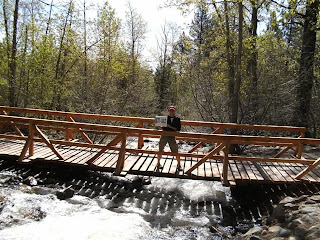
This is a great opportunity to learn about your local watershed and get more involved in a great locally driven environmental event. Also, the data collected on this day helps provide a “snapshot” of water quality and stream conditions all throughout the watershed.
For more information about Snapshot day, or if you would like to participate next year (either as a team leader or a volunteer), email Mary Kay Reidl at mriedl@ndep.nv.gov.
This year, our Client Services Representative, Brian Wadsworth, participated in Snapshot day!
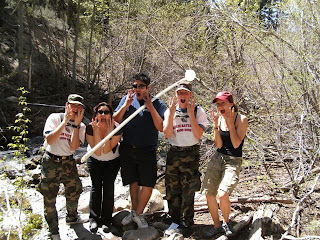
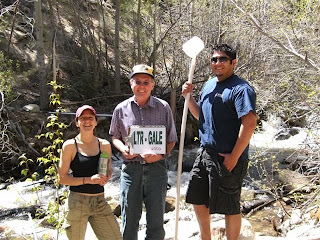

You can also contact Brian at brianw@wetlaboratory.com for more information!
 >
>


