 >
>


As summer comes to a close, another dry season has taken its toll on Southern Nevada water supplies.
Drought conditions have dropped water levels in Lake Mead to “near critical levels,” according to 8newsnow.com, putting Las Vegas Valley water supply in a tight spot.
The situation has gotten bad enough that Las Vegas water officials may seek federal disaster aid, according to ktvn.com.
In a comment to the Las Vegas Review Journal, Southern Nevada Water Authority chief Pat Mulroy compared the severity of the situation to Hurricane Sandy, which hit the East Coast last year.
Lake Mead’s water level has dropped more than 100 feet since 2000, according to ktvn.com.
If Lake Mead drops to 1,075 feet, Nevada will be forced to cut water usage by 4 percent, according to 8newsnow.com. The lake was at 1,106 feet, as of August 8, and falling fast.
The Southern Nevada Water Authority cannot pull water out of Lake Mead if it drops below 1,000 feet, but is drilling a third “straw” into the lake to gain deeper access in case levels continue to drop.
Many are viewing this as a long-term issue, and one that will have to be dealt with on a larger scale.
“They really all see, as do most scientists, the fact that we’re not really in a period of drought. It is climate change,” Dr. Stephen Parker of University of Nevada, Las Vegas, told 8newsnow.com.
And according to federal water experts and climatologists, the picture is grim for all of the South West that depends on the Colorado River for water, according to an article in the Las Vegas Sun.
Demand for water from the Colorado River exceeds current supply, according to the article, meaning the government may have to spend between $4 and $7 billion to ensure a more stable supply for Nevada, Arizona, California, Utah, Colorado, Wyoming and New Mexico.
This situation only reinforces the importance of properly, and carefully, managing not only our water supply in the west, but insuring the water we do have is kept at high water quality standards so it isn’t wasted.

Image via: http://pyramidlakeflyfishing.com/
What’s living in Northern Nevada’s water is an important indicator of water quality for our area, and in some cases can affect water quality, so news on aquatic species is always of interest here at WETLAB.
First, the good news. As reported by Tom Knudson in the Sacramento Bee, the Pyramid Lake Lahontan Cutthroat Trout is recovering from near extinction.
“This is such an exciting story because this was such a unique fish,” said Mary Peacock, an associate professor of biology and genetics expert at the University of Nevada, Reno, in the Sacbee story. “You can see pictures from the early part of the 1900s with people holding really large trout out of Tahoe or Pyramid. We thought those fish were gone.”
The particular strain of Cutthrought Trout was overfished in the 1920s and 30s, but the construction of the Derby Dam on the Truckee River to divert water meant the fish could no longer reach their spawning grounds, dealing what was thought to be the final blow, according to the story.
But survivors were found in an unlikely place, Morrison Creek on the Nevada Utah boarder, and a slow, tenuous reintroduction was underway.
On the scarier side of aquatic wildlife news, the Reno Gazette Journal is reporting that the Nevada Department of Wildlife has confirmed that New Zealand mudsnails – an invasive species that can do serious damage to a lake or river, has been detected in the Truckee River.
The small snail can be the size of a grain of sand or up to an eighth of an inch, but can out-compete native species and wreak havoc on a stream’s ecosystem, according to the article.
Looking upstream to Tahoe and other lakes that feed the Truckee River, the specter of invasive species may not be as ominous as once thought, however.
An in-depth review of national scientific studies indicates that quagga and zebra mussels, long thought to pose a significant risk to Tahoe, Donner and other area lakes, may not be able to survive in the calcium-poor bodies of water, according to “the Saga of the Quagga” by David Bunker, published in Moonshine Ink.
This recent revelation has put mandatory, paid boat inspections on Donner Lake on hold, according to the article, while the science is reviewed.
These are all important issues for the Northern Nevada region’s water quality, and will all be important to keep an eye on as they continue to develop.
In this blog, we spend much of our time talking about water quality testing news, science and politics that we find interesting; but with this month’s blog, we decided to do something a little different.
Here at WETLAB we care about maintaining and improving water quality, above and beyond our roll in monitoring it. When we came across some tips for average citizens to help from www.cleanwateraction.org, we thought it was a great fit.
First is some news that’s been getting quite a bit of attention in the last few years: Don’t flush medicines, pharmaceuticals or personal care products down the toilet or down the drain. That includes anything from over-the-counter drugs to cosmetics and even sun screen or vitamins. They can all impact both the environment and our drinking water down the road.

Don’t use antibacterial soaps when you don’t need to. These products often contain chemicals that harm aquatic life, and can lead to antibiotic resistant germs.
Don’t put motor oil, detergents, fertilizers, pesticides or anything but water down storm drains. And speaking of motor oil, fix any drips or leaks on your car or truck so it doesn’t wash into the water supply with the rain.
Try to use natural gardening products over pesticides or chemical fertilizers. The same goes for inside the home–stay away from toxic household products in cleaning and home care.
Pick up after your pets! Their waste contains bacteria that can end up in the water supply when it’s washed down the storm drain.
Pave less of your property. The more water runs across pavement instead of seeping down into the soil, the greater chance it has to pick up pollutants, pick up speed and cause flooding or erosion.
These are just a few tips we thought were worth sharing. Please add your ideas by commenting on this post or on our Facebook page.


Earlier this winter, we took a look at a promising beginning to the winter’s snowpack and corresponding water storage after big December storms.
Our January WETLAB blog reported end-of-December totals of 112 percent water content in the Sierra Snowpack that feeds the Truckee River and the Reno-Northern Nevada area downstream. At the time, that put us at 53 percent of the year’s total.
Fast forward to the end of February, and the picture is a little different – because the water is about the same. Yes, the months of January and February were the driest ever recorded for the Northern Sierra since modern records were first kept in 1920, according to the San Jose Mercury News, putting us at only 66 percent of normal to date.
Snowfall, stored in the Sierra to melt throughout the spring and summer as one of the major water sources for both Nevada and California, has been blocked by a ridge of high pressure off the West Coast for the last two months, driving storms up into Canada, and dropping them into the Midwest.
And accordingly, water officials are tightening their belts. The Walker River Irrigation District said farmers might receive about half of what they received last year, even though last year was also a below average year for water in the Sierra snowpack, according to the Reno Gazette Journal.
That – despite this year’s snowpack holding more water than last year – is due to drawn-down reservoir levels, according to Federal Watermaster Jim Shaw.
“I hate to bear crappy news, but being an old farmer, it doesn’t look very good,” Shaw said in the RGJ article. “If it’s any consolation, it’s this way clear across the U.S., from the Mississippi River west.”
While the April 1 deadline for measuring Sierra snowpack and water stored therein is quickly approaching, some local forecasters aren’t quite ready to write this winter off.
Snow Forecaster Bryan Allegretto of opensnow.com writes that, depending on which forecasting model you look at, there’s still a chance at feet of snow before the month of March is up.
The bottom line – if you’re an optimist, it’s not over until its over, but if you’re not, we’re unlikely to make up for the ground lost in January and February.
Sierra Snowpack water content off to a strong start!
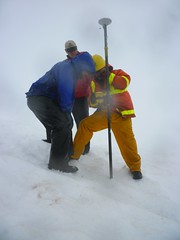
Measuring snow depth with GPS (Photo credit: WSDOT)
It’s that time of year again – the time when intrepid snow surveyors head out into the Sierra Nevada Mountains to assess how much water is stored in the winter’s snowpack.
California Department of Water Resources surveyors went out for the first look at the end of December and confirmed what we all expected – there’s a lot of water already stored in the snow, ready to flow downstream to Nevada and California in the spring.
The Central Sierra region, which includes the Truckee River – the primary water source for the Reno-Sparks region, holds 112 percent of normal water content for this date, and 53 percent of the yearly total measured April 1st each year.
The Northern Sierra reports 117 percent and 56 percent for those two stats, and the Southern Sierra shows 109 percent and 47 percent, according to the California Department of Water Resources.
After last winter’s dry spell, some in Nevada are still cautious, however.
According to a Reno Gazette Journal article, Federal Watermaster Jim Shaw told the Walker River Irrigation District Board to be cautious, with some long term forecasts showing below normal precipitation for January through March.
Frank Gehrke, chief snow surveyor for the California Department of Water Resources, shared the same caution in a San Francisco Chronicle article.
“We’ve got a real good start to the year, but still three months to go where we need to have more snow,” he said in the article. “From a skier’s standpoint, it’s gorgeous. You can’t get much better in California than we’ve got now. The thing that is always on our minds, though, is whether this sunny weather will keep up for long.”
Still, things look a lot better than last year, according to the article, with 4 feet of snow measured by Gehrke (1 foot of water content) this year, compared to 4 inches of snow – 0.14 inches of water – for the same time last year.
So the bottom line is this – we’re off to a good start, but let’s keep our fingers crossed for more snow to come!

Measuring snow depth with style (Photo credit: WSDOT)

Tahoe Governing Body Passes Water Quality Plan
Here at WETLAB, Western Environmental Testing Laboratory, we keep an eye on water quality issues throughout Northern Nevada and the surrounding region, and perhaps no other place within the region gets more attention than Lake Tahoe.
Recently, the Tahoe Regional Planning Agency, a bi-state agency that governs Lake Tahoe, passed an update to it’s 1987 regional plan in a 12-1 vote – an update that took the better part of a decade, according to an article in the Tahoe Daily Tribune.
The overarching goal of the plan is to reduce polluting runoff into the lake that reduces clarity – specifically targeting fine sediments that stay suspended in the water and nutrients that aid in growth, according to the article.
The updates specifically will allow investment in old, outdated properties that are known sources of runoff into Lake Tahoe.
But the TRPA has drawn criticism from both developers and from environmentalists, and it’s contentiousness has drawn the discussion out over many years.
Developers believe the Regional Plan to be to restrictive of construction and development so far as to hamper economic growth, while environmental groups contend the plan does not do enough to address the TRPA’s environmental goals.
The update allows increased building height, building density and developed coverage around the lake, according to critics, the article states.
“Earthjustice has represented local interests and conservation groups in the past to protect the lake and regions around its shoreline from unbridled construction and development,” said Earthjustice Attorney Wendy Park on the issue. “The population of California is growing rapidly and Lake Tahoe needs stronger, not weaker, protections to stay the very special mountain lake everyone cherishes.”
Whether the update is faced with legal challenges is not yet known, according to the article.
This will be an interesting water quality issue to watch, both for Northern Nevada and Northern California.

Winter Forecasting from WETLAB – Western Environmental Testing Laboratory

OSTM/Jason-2’s predecessor TOPEX/Poseidon caught the largest El Niño in a century seen in this image from Dec. 1, 1997. (Photo credit: Wikipedia)
This time of year, many skiers, snowboarders and other snow-lovers in Northern Nevada and elsewhere start to wonder what kind of winter is coming.
But the winter’s snowfall affects more than just the ski slopes – it’s what supplies water to much of Nevada, California and the rest of the west. Here in the Reno area, the forecasts that get the most attention is what will happen up the hill in the Lake Tahoe Region.
There are a variety of long-term forecasts to choose from, and all have varying levels of success.
Accuweather.com first predicted big snowfall in the Sierra, but in their October 14 forecast, they’ve backed off, not predicting above or below average snowfall for the region.
“Rain and (mountain) snow in California this coming season, I believe, will be near normal for the most part. A little bit more in the southern half than the northern half is expected,” said AcccuWeather Long-Range Forecaster Paul Pastelok.
The long-standing Farmer’s Almanac calls for milder than normal temperatures than normal, with average precipitation.
Early indications showed the possibility of El Nino conditions, created by warmer temperatures in the Pacific that historically have meant more precipitation in the Southwest and less in the Northwest, but according to a local forecaster at tahoeweatherdiscussion.com, El Nino conditions continue to weaken.
It’s tough to tell what El Nino, or its opposite, La Nina, mean for the Reno-Tahoe area, as last year’s below average snowfall came with a weak La Nina, and the huge snowfall of the winter before came with a stronger La Nina.
On 14 of the last 60 winters have been neutral – neither La Nina or El Nino – making predictions even more difficult, according to tahoeweatherdiscussion.com.
So the bottom line? There don’t seem to be any strong predictors yet. We’ll have to wait and see what the winter brings, and hope for the best to replenish our water supplies.

English: Snowy forest in Boreal, near Lake Tahoe, in the Sierra Nevada of California. (Photo credit: Wikipedia)

Stopping Nevada Water Pipeline With Snails?
Here’s an interesting water quality story bubbling up in Nevada right now: an environmental group has filed a suit to get four species of tiny springsnails as protected to keep Las Vegas from pumping billions of gallons of water from rural areas.
The Southern Nevada Water Authority has been granted approval in March to pump up to 84,000 acre-feet of groundwater a year from four rural valley to Las Vegas by Jason King, Nevada’s state engineer, according to an article by the Associated Press.
In August, the U.S. Bureau of Land Management recommended approval of the 280-mile long pipeline that would cost $3 billion.
Las Vegas has been the center of water controversies in the past with its rapid growth and associated thirst – a metropolis now home to 2 million people and host to 40 million tourists a year.
And Environmental groups have argued the plan to pump water would greatly reduce ground water levels – threatening wildlife, agriculture, ranching and rural communities, according to the AP article.
The latest lawsuit from the Center for Biological Diversity was filed in the U.S. District Court in Washington DC, asking the Fish and Wildlife Service to issue conclusions on whether the bifid duct, flag, hardy and Lake Valley pyrg springsnails deserve protection under the Endangered Species Act, according to the article.
In a preliminary finding last year prompted by a petition from the Center for Biological Diversity in 2009 found the snails, measuring about an eight of an inch to a quarter of an inch in size, may warrant protection.
The suit doesn’t target the Southern Nevada Water Authority or its pipeline project, but would give opponents more ammunition in fighting it, according to the Associated Press.
The snails date back to the ice age, said Rob Mrowka, a Nevada Advocate with the Center for Biological Diversity in the AP story, isolated as ice receded to evolve independently in accordance to the conditions of each spring.
They are an important part of the ecosystem, depended on by frogs, toads dragonflies, damsel flies, desert fish, birds and animals, according to the article.

WETLAB’s Insight into Water Wars
A Little Bit of History Repeating: California Water Wars
Look throughout history, and water’s vital importance has played a key role in shaping our planet, our societies and our politics. That’s why making sure what water we have is useable is so important, and why we take our water quality work seriously at Wetlab. Just look to our neighbor to the west – California’s history with water has occasionally been a contentious one. The center of the conflict is just a few hours south on Highway 395 along the Eastern Sierra.
In the beginning of the last century as Los Angeles started to outgrow local water sources, William Mulholland, head of the Los Angeles Department of Water and Power, acquired water rights throughout the Owens Valley and up to Mono Lake.
This heavily impacted agriculture and ranching in the area, turning Owens Lake into a dust bowl, leading farmers to try to destroy the aqueduct. This was the backdrop for the 1974 film Chinatown, staring Jack Nicholson, which fictionalized unscrupulous dealings that brought water from the Owens Valley to Los Angeles via the Los Angeles Aqueduct.
Environmental groups worked to mitigate the damage, and the Mono Lake Committee through litigation was able to stop Mono Lake from the same fate as Owens Lake to the south in the 1990s with a plan that should partially restore the receding body of water.
But tension still exists over the century-old water dispute, with the Los Angeles Department of Water and Power recently challenging the Mammoth Lakes Water District, filing suit over water rights to Mammoth Creek, according to www.sierrawave.net.
“The Mammoth Creek flow is approximately 25% of the City’s water export from the Eastern Sierra,” says the agency in a complaint filed in Mono County Superior Court, as quoted in www.courthousenews.com.
“The citizens of Los Angeles depend on flows from Mammoth Creek, and the L.A. Department of Water and Power has a responsibility for protecting the city’s water rights,” said DWP Director of Operations Marty Adams, in a written statement as quoted by the www.northhollywood.patch.com. “Taking water from Mammoth Creek reduces the volume of water to which Los Angeles has prior rights, that can be delivered to the citizens of Los Angeles, directly translating to our customers who pay our water rates.”
The head of Mammoth’s water district Greg Norby disputed the claim in the same article: “It’s fundamentally false and without merit,” he said. “Less than 1 percent of their water is exported from here. We’ve told them the amount is immeasurable, but they won’t listen.”
But the effects on Mammoth would be more damaging, Norby said. We’ll have to wait and see what the resolution is to this latest chapter in just one of the ongoing water rights sagas of the west.

Image via Wikipedia


