 >
>

No one living on the West coast has been able to escape the boisterous predictions about El Niño and its potential impact this winter. At WETLAB, we have been keeping a close eye on what the experts are saying about the storm, and keeping our fingers crossed that it means lots of new snow. However, there are new predictions out saying that El Niño may bring a lot of moisture, but it might be warm. This spells bad news for our drought-stricken region, where it was recently found that the snow pack in the Sierra Nevada’s is at a 500-year low. Of course, some moisture is better than none, but rain brings a higher possibility of mudslides and erosion. Sadly, there is no way to know what’s going to happen until it happens, so now we must all wait with baited breath and crossed fingers, hoping for snow.

Predicted El Niño weather pattern, courtesy of Accuweather.com
Nevada is home to many beautiful, expansive, and green golf courses. But, Nevada is also a dry, arid desert which is currently going through a severe drought, and there’s no end in sight. How are these two seemingly irreconcilable realities coexisting? Well, that’s a multi-faceted answer.
Golf courses go hand-in-hand with Nevada’s hospitality and luxury industries, and companies would be hard pressed to simply let their green investments die a brown, crunchy death. So companies, and courses, have gotten a little creative. While they started with the obvious measures of reducing overall usage, and examining pipes for leaks, the reduction was simply was not enough. Golf courses have now started using treated effluent water as a means for watering their massive lawns. Many courses in Nevada, especially those lining the Las Vegas strip, have used gray water for several years, but effluent water is a newer usage concept. Effluent water differs from gray water in that it must be more treated, since it can contain sewage. Using effluent water, instead of fresh water or even gray water, means a reduction of demand for potable water, which in turn means that our dwindling water supply can hold out a bit longer.
Northern Nevada golf courses have capitalized on the use of treated effluent water as a means to water their grass. It’s clear that the water-saving measure isn’t negatively impacting the golf courses, too, because the lawns are bright green and thriving. You just have to drive by Washoe County’s Sierra Sage Golf Course in Stead to see that this is a great way to water the turf. Sierra Sage gets their water from the City of Reno’s Stead Water Reclamation Facility, where the effluent water is treated to the point where it is no longer dangerous, but still not potable.
Another impact of this ever-worsening drought? Shorter winters mean more time on the putting green.
WETLAB tests effluent water for EPA compliance, and water for golf courses is no exception. WETLAB will also test all of your runoff and fertilizer samples, call (775) 355-0202 for more information.
Effluent water could soon become part of your normal drinking water in Northern Nevada. According to KTVN, reclaimed water is around 30% cheaper than potable water, but the problem is that waste water is not drinkable yet. Yet is the key word here, because regulations that define how much the water will need to be treated are working their way through the Nevada state legislature, and lawmakers are hoping to see them adopted by the 2017 session.
As everyone knows, Northern Nevada is suffering a severe drought. Having another way to reuse water will have a great, positive environmental impact on our already low waterways. Effluent water is already being used in some ways, mostly to irrigate parks and golf courses, but more could be put back into eventual use by the proposed measure. The process involves injecting semi-treated water directly into the ground, so that it will later make its way back into our pipes. This will ease the strain that is currently put on the Truckee River, which will in turn help with our ecosystem.
Effluent water is defined as waste-water, whether treated or not, that flows out from an industrial treatment plant or sewer. Secondary effluent is that same water that has been treated, but not to the point of purity. Obviously, the main difference between potable and effluent water is the cleanliness of the water, and its fitness for human consumption.
WETLAB preforms several tests on effluent water for many different clients, including public and private companies. Some of these tests are Biochemical Oxygen Demand (BOD), which tests how much oxygen demand the effluent water has, and Total Suspended Solids (TSS), which tests the amount of suspended solids within an aqueous sample. Several other tests are often performed in tandem on effluent water samples, including Total Nitrogen, Nitrate + Nitrite, Ammonia, Total Phosphorous, and Fecal Coliform. These tests all provide a detailed profile of what exactly is contained in an effluent sample, and allow proprietors to know how to best treat their water.
Singapore and Texas have already implemented effluent-to-drinking-water purification systems, with positive results. To read more about this program in Nevada, and to see an interesting news report on it, click here.
WETLAB has been participating in Snapshot Day for several years now. We’re proud of our commitment to education, and we hope to inspire ecological stewardship in students of all ages, while also showcasing various career paths they might not have considered previously. WETLAB directed three monitoring stations this year, meaning we were given the chance to inspire over one hundred students. Below is a guest blog written by Mary Kay Wagner, the coordinator for Snapshot Day.
Education on the River: Truckee River Snapshot Day
Mary Kay Wagner, Lower Truckee River Snapshot Day Coordinator
The ultimate learning experience occurs when students perform their own investigations and discovery. That opportunity was provided for Washoe County School District students during the 15th Annual Truckee River Snapshot Day on May 15, 2015. Under the guidance of resource professionals, students take a picture of one-moment in time of the Truckee River by collecting water quality data and studying the riparian habitat. They also learn about watershed concerns and stewardship practices.
For the lower Truckee River segment, nine schools sent 239 students ranging from 4th grade to high school to participate in the event. The student monitoring teams are pre-assigned to various monitoring sites to perform a stream walk (visual assessment), collect field data and water quality samples, and take photos. Streams are field tested for dissolved oxygen, conductivity, pH, and temperature. Water samples are taken to the Nevada State Health Lab and analyzed for turbidity, nutrients, and fecal coliform bacteria. Monitoring teams also collect debris and trash – things that don’t belong in the river.
One added value of Snapshot Day is the opportunity for students to learn and work alongside natural resource professionals, exposing the students to exciting careers and transferring ecological stewardship principles to a new batch of field recruits.
The success of this hands-on educational event is attributed to the dedicated Team Leaders from WETLAB, Great Basin Institute, Sierra Nevada Journeys, City of Sparks, City of Reno, Nevada Division of Environmental Protection, Nevada Department of Transportation, The Nature Conservancy and Pyramid Lake Environmental staff, who helped students understand watershed concepts and hydrology, as well as the importance of environmental stewardship. Participating schools included Mt. View Montessori, Natchez Elementary School, High Desert Montessori, Sage Ridge Middle School, Excel Christian School, Spanish Springs High School, Washoe Innovation High School, a home-school group and the Washoe County On-Line School.

A student collects a water sample from Hunter Creek during Snapshot Day 2015.
According the Reno Gazette-Journal, the recent rains experienced by northern Nevada and Lake Tahoe will ultimately have little impact on lake water levels. The recent precipitation has pushed Lake Tahoe up to its natural rim, but will drop as the weather continues to warm.
There has been a reported 1.42 inches of rainfall in South Lake Tahoe between May 14 and 25, and just about one inch in Reno-Sparks.
While any rain is good for our local water table, the amount we received in May is simply not enough to make a large difference for the rest of the summer. By the end of the summer, Lake Tahoe is expected to be several feet below its rim.
The long standing drought in California and Nevada shows few signs of stopping anytime soon.
More about this story can be found here.
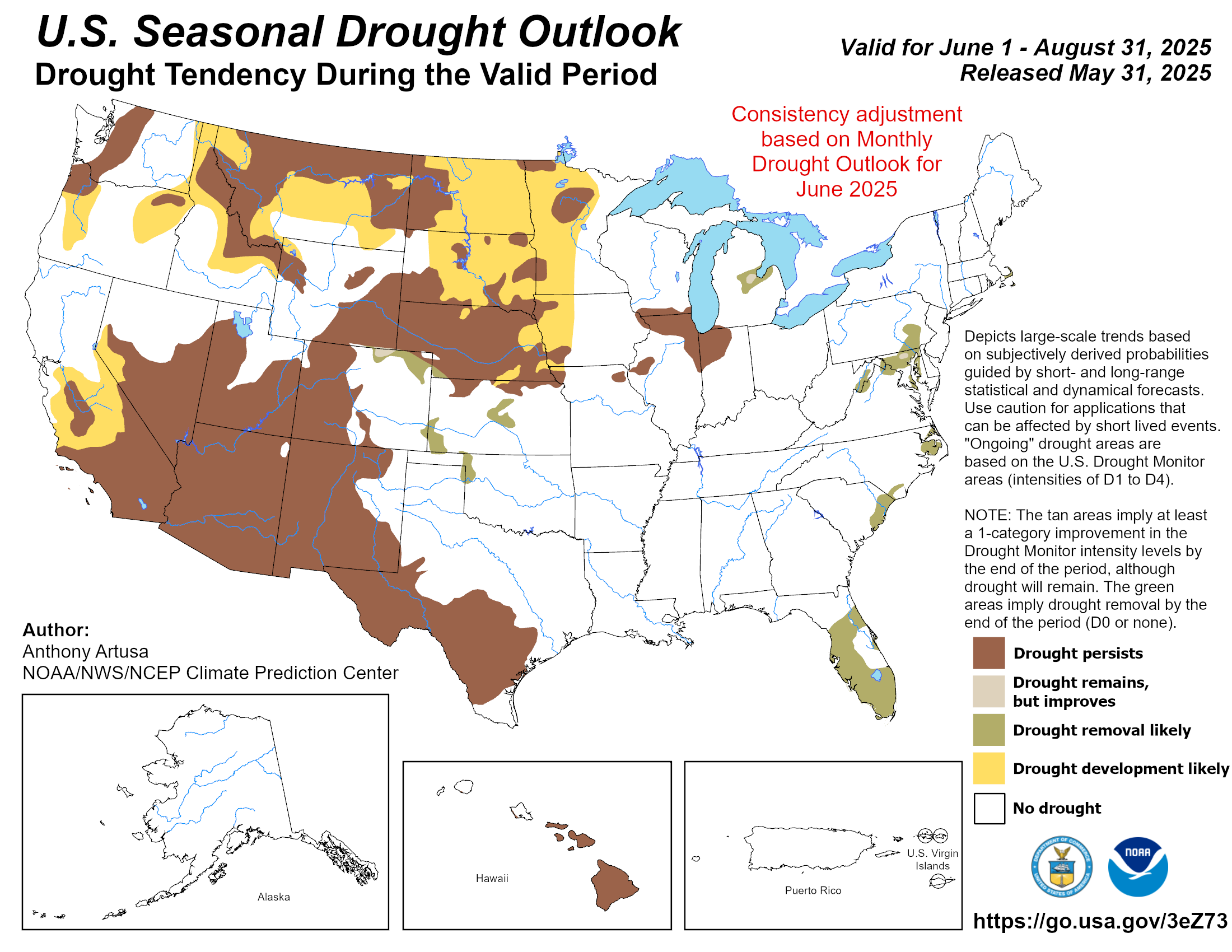
2015 Seasonal Drought Outlook, Courtesy of the National Weather Service Climate Prediction Center
Wetlab’s Phaedra Harmening and Gerry Miller recently spoke at a Cub Scout’s Overland District’s Club Scout Day Camp on Saturday, June 14 in Elko County.
Over 150 Cub Scouts visited Wetlab’s Botany Bay, one of nine stations that included archery, armor making, dragon training, knights in space and tournament sparring. At the Botany Bay station, Harmening and Miller gave each scout a pencil and notepad for notes, and worked with the Scouts on ecological concepts.
One question they posed was, “if Elko County’s population is 50,000, with four zeros, how many zeros are in the current world population of seven billion?”
Harmening and Miller likened the Scouts and their parents to members of a species they called “Overland District Scouts,” who, at the end of the day, would all go back to their individual ecosystem niches, using the analogy to explain the introduction of algae, bacteria, dragons and works into ecosystems.
The two Wetlab volunteers discussed the water cycle, how nature abhors a vacuum, and the place of the top three cereal crops – rice, wheat and corn – as they are used to feed the world.
At the end of the day, when the Scout camp came to an end, the Future Knights of the Round Table gave the loudest round of applause to the scientists from Wetlab.
Each year, Galena High School hosts a Career Fair for its sophomore students. The goal of the career fair is to expose students to the possibilities and realities of a successful career path. Sophomores are invited because 10th grade is often the point at which they begin looking into colleges and potential career interests. Professionals from various backgrounds participate as speakers, teaching kids about their jobs including education, how they got to where they are, volunteer service, the importance of networking and more.
Starting the day early at Galena High School, our group set up displays. We had pamphlets with pictures of the lab, a beaker filled with concentrated beet juice and an Erlenmeyer flask with diluted beet juice to show a small portion of lab processes. Most importantly, we had the WETLAB mascot, a Labrador, with its personal protective gear on to demonstrate the importance of safety and to show that science can be fun. These items provided visuals for the kids and were used during our presentations. We engaged the students by asking questions about their own interests and discussing how there are many different and exciting careers in the scientific field.
The first groups of students did not have many questions, but had a genuine interest in a diverse range of careers in the scientific community. The later groups were more vocal and asked questions ranging from work hours, how often we dealt with the public and the amount of technology available to work with. We hope we sparked some interest and motivation in the children that are our future.
We presented to six groups of sophomore students for 20 minutes each. We talked about what WETLAB does and why our business is so important. Most students seemed fairly knowledgeable about water quality and the need for testing in Nevada, as well as locally here in the Truckee Basin. Each of us discussed our education and work history as well as provided suggestions for volunteering and networking. With different backgrounds and career paths, the students got to hear our individual perspectives and learn about the unique experiences that led us to our current careers. This helped to emphasize that there is more than one way to find an interesting and fulfilling career if you follow your passion. While we all had varying messages, the resonating theme was to stick with your studies, despite the challenges, because in the end, a career in science is very rewarding.
While it will be a few years before these kids enter the workforce, their desire for a career in science and the level of interest is encouraging. Our industry has a promising future if we continue to feed young minds and encourage them, teaching them how to deal with challenges and overcome obstacles to pursue what is important to them. Hopefully, networking in a more intimate setting plants the seed that will inspire them to grow toward their goals, prepare for higher education and gain crucial career experience.
With the Sierra snowpack 1/3rd of normal for this time of year, it doesn’t look like a recovery from drought conditions are likely, according to an article on KSBW.com.
A survey earlier this month found the Truckee River Basin was only at 32 percent of normal, the Tahoe Basin was at 47 percent and the Carson River Basin was at 55 percent, according to the article. It’s an improvement from a month prior, where the snowpack was as low as 14 percent of normal.
While reduced irrigation and watering are a typical reaction to pending drought conditions, some experts in the Reno area are actually urging residents and businesses to water trees to help them survive the drought, according to an article written by the Associated Press.
The Reno Urban Forestry Commission says the region has seen a significant increase in tree deaths over the past several years, which is a threat to public safety and requires costly removal, according to the article.
As Nevada ranchers, farmers and residents brace for a desperately dry summer, one big glimmer of hope is emerging in this third year of drought.
Climate scientists are becoming increasingly confident that El Niño conditions will emerge by the end of this upcoming summer, boosting the chances for a wet, snowy and potentially drought-busting winter next year. El Niño is a climate phenomenon caused by warming water in the Pacific Ocean. In the past, El Niños have produced prodigious winters on the West Coast, including soakers like 1997-98 that dropped more than 36 inches of rain in Sonoma County in February alone. That same winter more than 186 inches of snow fell in February at Alpine Meadows ski resort.
El Niños do not guarantee a big winter, but according to the Western Regional Climate Center, “El Niño usually (not always) brings wetter winters to central and especially southern California. Large El Niños (a very limited sample) appear to extend wet conditions further north.”
Some climate scientist are calling for a 75 percent chance of an El Niño year next winter, which should be welcome news for ranchers and farmers in Nevada who are already planning to stop planting crops this season or reduce the size of their livestock herds because of the scarcity of water.
As skiers, ranchers and farmers know, weather forecasting is notoriously fickle even days before a storm, and predicting winter weather nearly a year in advance is admittedly imprecise. But El Niño’s potential to drench the West Coast with powerful, jet-stream-propelled storms is well documented by climate scientists.
In a winter were storms have been few and far between, that hope of an El Niño winter that will end the drought by filling reservoirs and re-charging aquifers is a welcome piece of positive news. Climate scientists will continue to track the warming Pacific Ocean temperatures through a vast network of buoys. How much the ocean warms over the next several months could have a dramatic impact on whether the winter of 2014-15 is a drought-busting season of storms, or another year of parched conditions.
The Sierra’s first snow survey, conducted early this month, indicated what we already knew – it’s the beginning of another dry year.
According to a recently published article in the Sacramento Bee, California experienced one of the driest starts to winter ever recorded. In fact, in its first snow survey, the California Department of Water Resources found the snowpack at only 20 percent of average – a water supply crucial to both California and Nevada.
In the northern Sierra, according to the Bee, which supplies much of the Reno-Sparks’ area water via the Truckee River, the snowpack is just 10 percent of average.
That stacks up to 9.3 inches of snow depth – 2.3 inches of water content – at Echo Summit near South Lake Tahoe, according to an article in the Sierra Sun.
The results weren’t surprising after 2013’s record-setting drought, the driest in California’s 119 years of data, according to the Western Regional Climate Center in Reno.
“The water situation is bad; we’re kind of in unprecedented conditions. We’re looking at a year that’s potentially going to be worse than the 1976-77 drought,” John Woodling, executive director of the Sacramento Regional Water Authority, noted in the Sacramento Bee article.
Reports by the Reno Gazette-Journal indicate that if the weather keeps up, California will only be able to deliver 5 percent of the water requested by 29 public agencies this year.
“While we hope conditions improve, we are fully mobilized to streamline water transfers and take every action possible to ease the effects of dry weather on farms, homes and businesses as we face a possible third consecutive dry year,” said Mark Cowin, director of the Department of Water Resources in an issued statement.
At Lake Tahoe, officials are already urging conservation, according to the Sierra Sun.
“Every gallon a customer conserves will help preserve the necessary water resources available during a drought situation,” Tony Laliotis, director of utilities for the Tahoe City Public Utility District told the Sun. “Conserving water in the winter is just as important as conserving in the summer.”
The season isn’t over yet though, as some officials have pointed out.
“One giant storm can turn it around,” said Steven Poncelet of the Truckee Donner Public Utility District in the Sierra Sun article.


