 >
>

Our ongoing series Life of a Sample explores what happens behind the scenes at WETLAB. If you missed part one, check it out here!
The next step for a sample at WETLAB is sample preparation. This process takes one day, and involves several different processes and people. During the first step, all samples undergo the same log-in and review procedure, and sample prep is where the tests begin to diverge dependent on which analyses are required. Some samples, including many soil tests, require the compositing of several different samples into one representative batch. For many tests, different filtered and unfiltered aliquots are needed; these pieces are split up into different bottles and preserved as needed. Once properly split, the samples are released to the lab.
Before the samples reach the lab, laboratory scientists clean and prep the necessary equipment, and lab technicians prepare batches of samples based on the tests logged in during step one. Some tests are ready to preform immediately, and those move on to step three. For others, extractions are needed. This includes TCLP (toxic characteristic leaching procedure), cyanide extraction, MWMP (meteoric water mobility procedure), and humidity cells. Some of these extractions take more than one day, like humidity cells, which can continue for a few months up to several years. Ensuring proper preparations are preformed allows the rest of the analysis to run smoothly. After the filtering and extractions are completed, it’s time for step three: distillation and digestion.

A portion of the humidity cells currently being processed in the geochemistry lab.

MWMP extractions.
The EPA revised the Total Coliform Rule (TCR) in 2013, but these changes need to be implemented soon. By April 1, 2016, all compliant public water systems will have to implement the revised TCR requirements. At WETLAB, we take a great interest in the new regulatory measures that affect our clients, and we decided to take a closer look at what the Revised Total Coliform Rule entails.
According to the EPA, the RTCR is intended to “protect public health by ensuring the integrity of the drinking water distribution system and monitoring for the presence of microbial contamination.” Which essentially means that the RTCR confirms what the TCR has already established since 1989, and then expands upon the initial rule. The RTCR requires that all public water systems (PWS) show that they meet the legal limit for E. coli through expanded required monitoring. The rule also goes on to specify what the actual frequency and timing of the required microbial testing is; which is based on the populations served by the PWS, the type of PWS, and what type of source water the PWS uses.
To find the exact requirements of the new rule, we highly suggest visiting the EPA’s page on the RTCR here. These changes do not have to be implemented until April 1, 2016, but it is crucial to have an accurate understanding of the new rule.
At WETLAB, we strive to provide our clients with the most accurate and up-to-date information available. If you have any questions, about this rule or any other, please call us at (775) 355-0202.
Participating in events that benefit our community is important to all of us at WETLAB. Below, one of our lab techs tells us about an event she participated in earlier this year benefiting the Food Bank of Northern Nevada.
CANstruction – March 5, 2015
Maiya Greenwood
CANstruction is a charity competition where participants design and build giant structures made completely from canned food. At the conclusion of the competition, all of the food is donated to the Food Bank of Northern Nevada. The participants range from engineers and architects to boy scout troops and school students. This year’s event was impressive, exciting and charitable! There were five categories: best meal, best use of labels, structural ingenuity, juror’s favorite, and an honorable mention.

“Scouting for Food”

Juror’s Favorite- “CANcraft”

Best Meal- “Castle Made of Dreams”

Best Use of Labels- “Give S’more to the Food Bank”
We are in the process of tripling the space of our semi-volatile organics lab!
Construction is expected to be done mid-August, with the expansion fully functional (hopefully!) by the end of September. The expansion will nearly triple the square footage of Bruce’s lab, and the new equipment will essentially double capacity. The new instrument is a GCFID, which is for running TPH analysis (and could in the future run alcohols, gylcols, and qualitative, not just quantitative, TPH), and will be used to do just extract-ables, with the old GCFID being relegated to just purge-ables. In the old lab, where the instruments currently are, a six-foot fume hood will be installed, and all instruments will be in the expanded area. This new area will have six “instrument stations,” with counter space and vents, but only three will be used for right now. This is exciting news because this means there are further opportunities for growth!
This week, TPH and HAA5 sample results may be a bit late, but all result and sample flow will return to normal right after that! This expansion will help WETLAB nearly double our sample capacity, and will give Bruce some much needed space in his lab!
For questions and queries, please call our client services department at (775) 355-0202.
According to a recent article in the Tahoe Regional Planning Agency’s Tahoe in Depth Newsletter, the clarity levels of Lake Tahoe are improving. Lake clarity increased due to several factors, high among them being the continuing drought. Lower amounts of precipitation means less runoff into the lake, which means that fewer pollutants find their way into Tahoe’s waters. The extreme regional drought has brought a small glimmer of good news, but that news pales in comparison to its terrible effects elsewhere. However, if we focus on the bright side, Lake Tahoe clarity levels are at a decade long high.
Water clarity in Lake Tahoe is measured using a Secchi Disk. The Secchi disk is a white disk that is lowered into a body of water. The clarity measurement is then obtained by seeing how far the Secchi disk can lowered into the water while still remaining visible. In Lake Tahoe, the clarity has historically been remarkable, with data suggesting clearness to approximately 120 feet. While the lake is nowhere near that clear now, currently hovering around 70 feet, it is still a measure of how the lake is currently faring in its ever-expanding use.
Water clarity is an important indicator of lake health. One of the reasons for Lake Tahoe’s remarkable clarity is due to the amount of rain that falls directly on the lake. Approximately 40% of rainfall that contributes to the lakes watershed is directly onto the lake itself. This is a very large amount of water that does not have to flow into the lake via runoff, meaning that the clarity is not negatively impacted.
Several measures have been taken to increase Lake Tahoe’s clarity levels, including the very popular “Keep Tahoe Blue” campaign (more information can be found here). Another important tactic is the institution of the Lake Tahoe Total Maximum Daily Load, which WETLAB has previously written about here.
WETLAB has been participating in Snapshot Day for several years now. We’re proud of our commitment to education, and we hope to inspire ecological stewardship in students of all ages, while also showcasing various career paths they might not have considered previously. WETLAB directed three monitoring stations this year, meaning we were given the chance to inspire over one hundred students. Below is a guest blog written by Mary Kay Wagner, the coordinator for Snapshot Day.
Education on the River: Truckee River Snapshot Day
Mary Kay Wagner, Lower Truckee River Snapshot Day Coordinator
The ultimate learning experience occurs when students perform their own investigations and discovery. That opportunity was provided for Washoe County School District students during the 15th Annual Truckee River Snapshot Day on May 15, 2015. Under the guidance of resource professionals, students take a picture of one-moment in time of the Truckee River by collecting water quality data and studying the riparian habitat. They also learn about watershed concerns and stewardship practices.
For the lower Truckee River segment, nine schools sent 239 students ranging from 4th grade to high school to participate in the event. The student monitoring teams are pre-assigned to various monitoring sites to perform a stream walk (visual assessment), collect field data and water quality samples, and take photos. Streams are field tested for dissolved oxygen, conductivity, pH, and temperature. Water samples are taken to the Nevada State Health Lab and analyzed for turbidity, nutrients, and fecal coliform bacteria. Monitoring teams also collect debris and trash – things that don’t belong in the river.
One added value of Snapshot Day is the opportunity for students to learn and work alongside natural resource professionals, exposing the students to exciting careers and transferring ecological stewardship principles to a new batch of field recruits.
The success of this hands-on educational event is attributed to the dedicated Team Leaders from WETLAB, Great Basin Institute, Sierra Nevada Journeys, City of Sparks, City of Reno, Nevada Division of Environmental Protection, Nevada Department of Transportation, The Nature Conservancy and Pyramid Lake Environmental staff, who helped students understand watershed concepts and hydrology, as well as the importance of environmental stewardship. Participating schools included Mt. View Montessori, Natchez Elementary School, High Desert Montessori, Sage Ridge Middle School, Excel Christian School, Spanish Springs High School, Washoe Innovation High School, a home-school group and the Washoe County On-Line School.

A student collects a water sample from Hunter Creek during Snapshot Day 2015.
According the Reno Gazette-Journal, the recent rains experienced by northern Nevada and Lake Tahoe will ultimately have little impact on lake water levels. The recent precipitation has pushed Lake Tahoe up to its natural rim, but will drop as the weather continues to warm.
There has been a reported 1.42 inches of rainfall in South Lake Tahoe between May 14 and 25, and just about one inch in Reno-Sparks.
While any rain is good for our local water table, the amount we received in May is simply not enough to make a large difference for the rest of the summer. By the end of the summer, Lake Tahoe is expected to be several feet below its rim.
The long standing drought in California and Nevada shows few signs of stopping anytime soon.
More about this story can be found here.
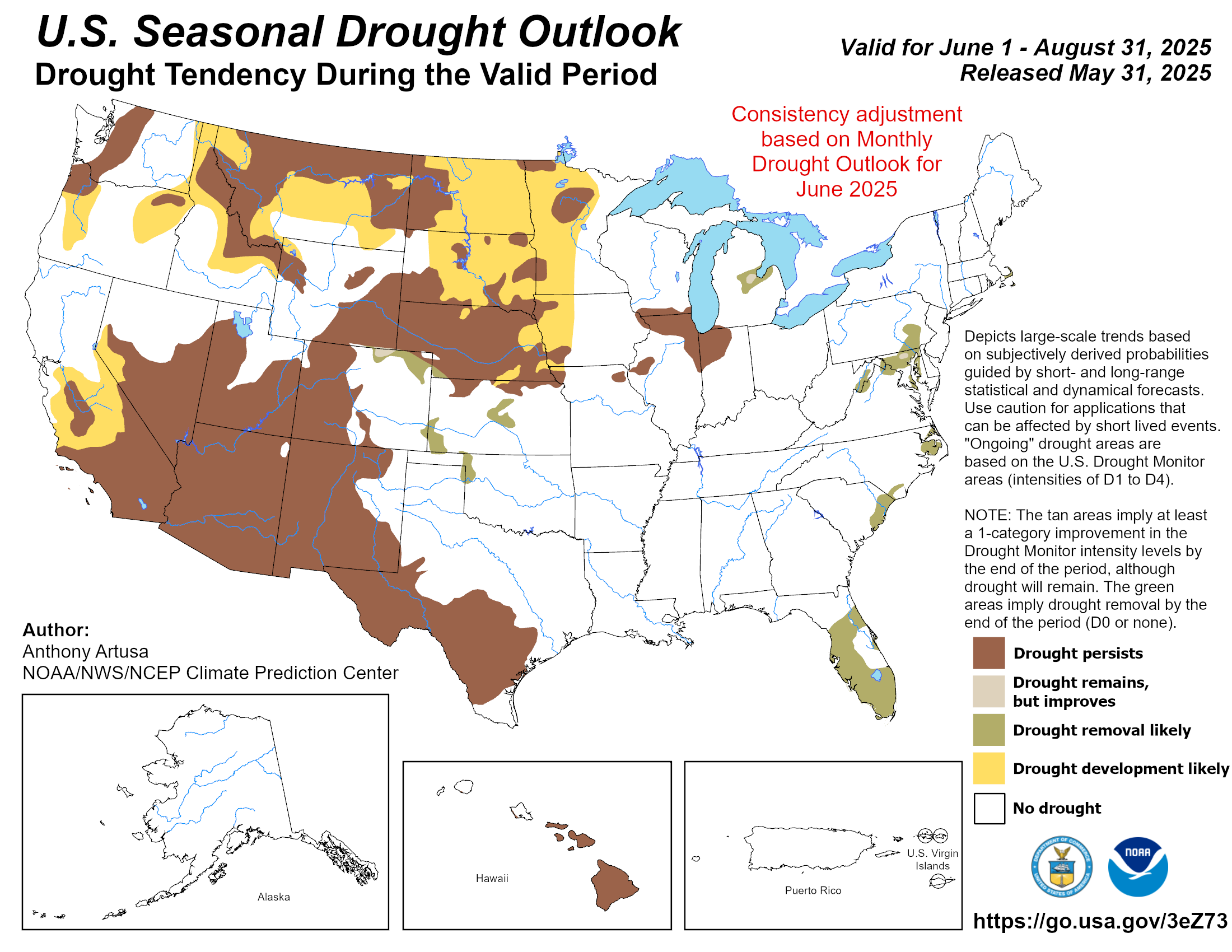
2015 Seasonal Drought Outlook, Courtesy of the National Weather Service Climate Prediction Center
We here at WETLAB are proud of our continued involvement in the community. That involvement takes many different forms, recently including helping to inspire young minds to be interested in science. Below, four WETLABbers share their experience presenting at a local high school’s career day.
Career Day at Galena High School: April 23, 2015
-Jennifer Delaney, AJ Lewis, Maiya Greenwood and Cory Baker-
Each year, Galena High School hosts a Career Fair for its sophomore students. The career fair exposes students to the possibilities and realities of a successful career path. Sophomores are invited because 10th grade is often the point at which they begin looking into colleges and potential career interests. Professionals from various backgrounds participate as speakers, teaching kids about their careers, their educations, how they got to where they are, volunteer services, the importance of networking and more.
WETLAB is now a veteran of this event, as this was our second year participating. We met early at Galena High School to set up the displays at our booth. We had pamphlets with pictures of the lab, Erlenmeyer flasks with concentrated and dilute green slime, yellow and red acid vials to represent Nitric and Sulfuric Acid, a specimen cup with pink solution to simulate the presence of CN (properly labeled on the cup), and a tiny volumetric flask dyed blue to simulate the presence of MBAS. Most importantly, we had the WETLAB mascot, the Labrador, wearing its personal protective gear to demonstrate proper PPE and to show that science can be fun. These visuals helped to engage the students by prompting questions that led to discussions about their own interests and the breadth of scientific study and career paths.
We presented to six groups of students for 20 minutes each. First we introduced what WETLAB does and the importance of our business. Most students seemed knowledgeable about the importance of water quality and the need for environmental testing in Nevada, as well as locally here in the Truckee Basin. Next, we each described our educational backgrounds, work experiences, and the importance of networking and volunteering. With different backgrounds and career paths, students were able to hear our individual perspectives and learn about our unique experiences that led us to our current careers. This helped to emphasize that there is more than one way to find an interesting and fulfilling career if you follow your passion. While we all had varying messages, the resonating theme was to work hard, build a professional network, ask for help along the way, and keep your doors open to different opportunities.
It will be a few years before these kids enter the workforce, but their desire for a career in science and their level of interest is encouraging. Our industry has a promising future if we continue to feed and encourage young minds, teach them how to overcome challenges, and pursue what is important to them. Hopefully, networking in a more intimate setting plants the seed that will inspire our future workforce to grow and work towards their goals, prepare for higher education, and gain crucial career experience.

WETLab’s booth to demonstrate a Laboratory Scientist career path.
For many years WETLAB has committed to giving back to our community. We believe it’s our responsibility to leave a mark and make a difference in the communities where we live.
Hello! My name is Nick Ross and I am the Operations Manager at Western Environmental Testing Laboratory. As part of our 2015 Volunteer Program we tasked ourselves to work together as a group for one large event. Ideas for the event were submitted by our staff in January and the company would vote on a cause to pursue before the end of February. As the ideas came rolling in, one in particular caught my attention.
The newest member of our team (Kat) nominated the Veterans Guest House. This is a special organization because of my family members that have served and sacrificed for this great country. My grandfather and uncle both served in the U.S. Navy. During World War II my grandfather was in the south Pacific for over 4 years spending the end of his time on or around the island of Kwajalein. I wish I knew more…but an already quiet man was even more subdued and didn’t like to talk about those moments in his life. This just proves the quote, “all gave some, some gave all.” And finally, my younger brother is a pilot currently aboard the USS Carl Vinson. Carl Vinson is deployed as part of the Carl Vinson Strike Group supporting maritime security operations, strike operations in Iraq and Syria as directed, and theater security cooperation efforts in the U.S. 5th Fleet area of responsibility. His sacrifice will be to miss the birth of his first child.
Those are some of the reasons why I personally felt connected to the Veterans Guest House. And why I wanted to help support the men and women that give so much. If you haven’t donated yet, please do and WETLAB will match your donation dollar-for-dollar before March 6, 2015. Visit www.VeteransGuestHouse.org/donate and enter WETLAB on the “Donation Note or Organization” line
Hello Gracious Readers,
My name is Lance Bell, and I am the Business Development Manager for Western Environmental Laboratory. I am writing today to share with you why support for the Veteran’s Guest House is important to me. Men in 3 of the last 4 generations of my family tree have faithfully served our nation in the armed services in some capacity. Both of my grandfathers served in WW II, including one who was shot down over Europe during an air mission and subsequently spent 3 years as a POW in a German Stalag camp. My Uncle was stationed in Europe during the Korean War, and now my oldest son serves as an Airmen First Class in the US Air Force Air National Guard.
I had the privilege to attend my son’s graduation ceremony from Basic Training at Lackland AF Base in San Antonio, TX in October of 2013. Every week some 300-500 airmen successfully advance, and it was inspirational to witness the dedication and commitment demonstrated by the men and women who have chosen to make as part of their dream and ambition the desire to protect this nation, and defend the values and principals upon which it stands.
As I think of the Veteran’s Guest House, I am reminded not only of my own family’s service, but also that of all those veterans and their families, and the sacrifices that they have had to make and endure because of their commitment to the rest of us. Here in Reno we have an opportunity to show our gratitude in support of something not only unique in concept, but noble in cause.
Visit www.VeteransGuestHouse.org/donate and be sure to enter WETLAB on the “Donation Note or Organization” line. Remember, if you donate before March 6th, 2015, WETLAB will MATCH your donation


